
The Actuality of Surrealism and Man Ray’s L’étoile de mer
Hello everybody!
Today I want to continue our Art History post, picking up the tale from last week.
Moving from Pictorialism to Surrealism
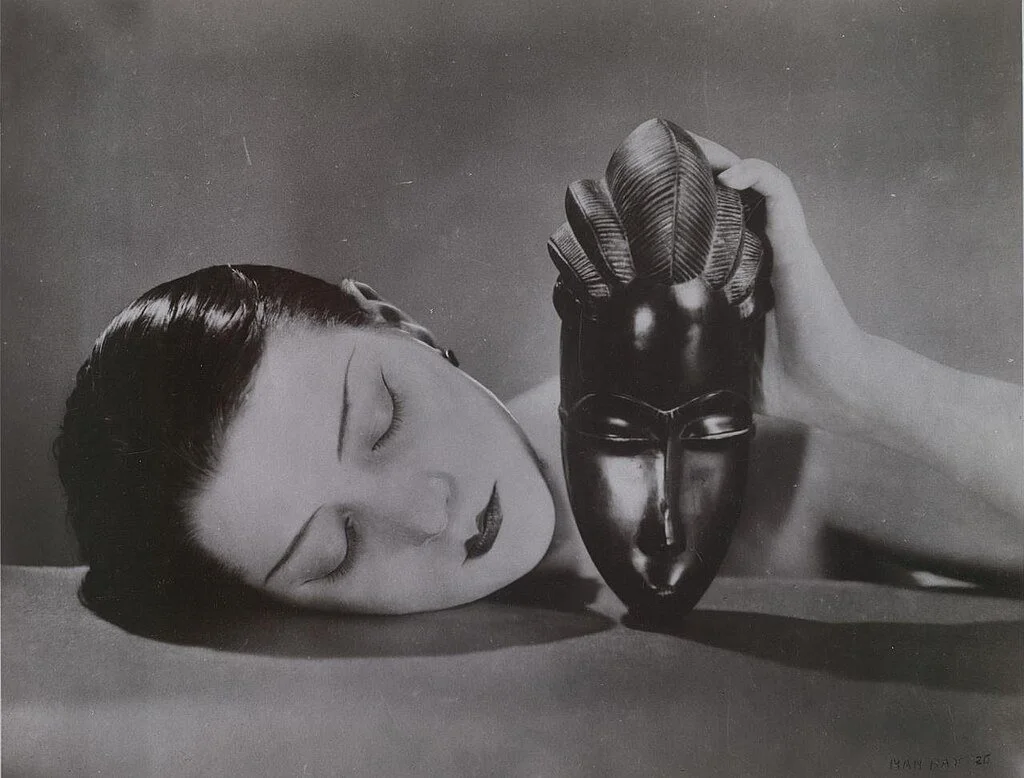
Kiki Noire et Blanche - Man Ray
Following the softness of Pictorialism and the work of Alfred Stieglitz, the next wave of Fine Art Photography—including Nude Fine Art Photography—was driven by Surrealism. This was a profoundly influential artistic movement that engaged media like Literature, Painting, Cinema, and, of course, Photography.
Born after World War I, Surrealism rejected the soft, romantic imagery of the previous era. Its primary aim was to let the unconscious mind emerge and express itself, overcoming the stark separation between the rational and the subconscious. The goal was to reach a "superior reality," or "super-realism," a state where both are active simultaneously.
Dreams and states of madness were considered instrumental and freeing tools to arrive at this heightened perception. Love was a main subject, often viewed as the essential, chaotic fulcrum of life. This remains intriguing to me because I observe that modern relationships are in crisis, surrounded by a negative and often stifling pressure.
Given the scope of this cultural movement, I cannot cover it exhaustively in one article, but among its many practitioners, the most compelling for our discussion is Man Ray.
Our Man – Man Ray

Carl Van Vechten, Public domain, via Wikimedia Commons
To Man Ray and his contemporaries, we owe a significant amount of experimental shooting and editing techniques. This includes the development of the Rayograph (photograms created without a camera) and solarization, a technique he refined in collaboration with Lee Miller. Other methods, like juxtapositions, double exposures, and collages, also flourished during the fragile peace between the world wars.
Man Ray was a man of many abilities who expressed himself beyond photography. He is a renowned film director, having produced a number of experimental short films. One of these is of particular interest: The Sea-Star (L’étoile de mer) (1928), which utilizes a frosted glass for much of its run and is driven by a sequence of surrealist poems by Robert Desnos.
Perfect Beauty as Glass, as Woman’s Beauty
L’étoile de mer, Man Ray 1928
To my eye, the film clearly embodies the movement’s central concepts. It speaks to a reality impossible for humans to truly grasp—seen vividly in the newspaper pages blown away by the wind, chased by one of the characters. This resonates deeply with our contemporary life, where we are constantly bombarded by information, making the search for genuine truth a real chase.
The beauty of the sea-star—perfect, remote, like glass—becomes a metaphor for a woman's beauty: a beauty that ultimately "kills," or at least, fundamentally alters the male protagonist.
The film's central message is the immanence and transience of human relationships. The "beauty" eventually becomes unsatisfied and leaves the man she started with, switching to another companion. The image of the woman protagonist wielding a knife (in the presence of the sea-star), the casual change of partner, and the crack appearing on the frosted glass lens—these cinematic devices feel like a prophetic commentary.
The Surrealist Dream Became a Modern Nightmare
In its simplicity, the film feels like a push toward our sad social reality, fostered by the concept of a "liquid society." Here, meritocracy is a joke, and higher-level positions are often reserved for the faithful, not the competent. Entry-level jobs—the ones that should allow young people to build a family, buy a home, and create community—are too poor, too easily interrupted, and difficult to replace (without resorting to emigration). These young people are the engine of the real economy, yet they are dismissed by grand bureaucrats, bankers, and politicians who banter about how fine it is to live on minimal wages and accuse the youth of being "too choosy."
Thus, in the modern year, the chaotic, awake dream lived by those Surrealist artists often feels like our common nightmare.
The psychological devastation caused by the legitimate act of a woman changing her heart too often leaves men without the instruments to process their mourning, anger, and fear of lasting solitude. Like a fresh, pulsating wound, that sorrow promises to stand forever.
This emotional void contributes to the worrying number of murders and sexual assaults against women by men—an avoidable tragedy that we see increasing even in countries with stronger social and work guarantees for women than my own.
An Important Theme to Me

Zooming on Beauty; ph: Francesco Coppola
This state of affairs fuels the urge I feel to express my personal experience through my artwork and seek answers from posing models. I believe that instead of pleading for a general return to "more traditional times," there is a profound need to celebrate the endings of relationships. No matter how harsh, despairing, or bleak the aftermath may look, there is always a constructive, positive, and better path after the end of a relationship.
I know the anger. I know the turmoil. I know the obsessive thoughts. I’ve been there—even after eleven years of day-to-day professed love.
The act of psychological separation — when a partner frees themselves and we must do the same — should be taken as a gift of freedom to everybody.
Better days will come, resulting in two parallel, existing, and vital existences. Both are worth living, both are worth seeking a better settlement.
Don’t waste your life following the Cupio dissolvi!
Shine on!