
Transitional Authors 1: Edward Weston
Foreword
In the previous articles, we started by focusing on Pictorialism and Stieglitz's work. After that came Man Ray's approach to Art Nude Photography, and in the third article we transitioned from Lucien Clergue to Richard Avedon, finishing with Herb Ritts—thus moving from a pure artistic drive to a more commercial use of nude images.
Naturally, this is a huge simplification. There are many more authors in Art Nude History that I haven't touched upon, and this is due to the limits of web articles and the average attention span of you, my dear reader.
What I want to highlight from now on is a group of photographers who, during their careers, moved from dreamy, artistic approaches to more detailed work that would eventually influence the commercial (Fashion Photography) field. The first and most influential figure of this type is surely Edward Weston.
Biography Highlights

Edward Weston, 1914
Edward Weston, born in Highland Park, Illinois, in 1886, approached photography as largely self-taught, taking only an official 9-month photography course whose concepts he mastered in just 6 months. At the age of 20 he had his first photo published in a magazine and opened his first studio in Glendale (at the time known as Tropico), California, in 1910.
Confident in his drive and skills, he initially adhered to the Pictorialist movement, for which he wrote articles as well as making photographs in that style, earning the attention and favor of the well-known photographer Alfred Stieglitz.
For our interest, crucial was his encounter with model and aspiring photographer Margrethe Mather, a stark contrast to his conservative upbringing. Mather introduced him to the contemporary Bohemian lifestyle and sexual freedom. In 1913 she became his assistant, and sometime in 1920 Weston started photographing nudes — a practice he continued throughout his long career.
Soon after, he met actress and model Tina Modotti, who quickly became his main model and lover. This encounter would lead him into his next creative period in Mexico. But first, during a visit to his native Ohio in 1922, he photographed an industrial plant, demonstrating his shift from Pictorialism to a new sharp-edged modernist style.

Tina Modotti by Edward Weston
In 1923, Weston traveled to Mexico with Modotti. The different culture there and the remains of the native Aztec descendant population brought him to see the world in new ways, focusing on still-life photos of day-to-day life with a clarity not shown before. He also took close nudes of Modotti. His work in Mexico established his reputation as a serious artist, even though his relationship with her eventually deteriorated, leading him to leave the country never to return.
Just before leaving for Mexico, he photographed Mather nude at Redondo Beach in a sharply focused style, showing her entire body in relation to the natural setting — images considered prototypes of en plein air nude photography.
Returning to California in 1927, Weston met dancer Bertha Wardell and created one of his most famous figure studies of her kneeling body. A trip to the Mojave Desert in 1928 led him to refine his well-defined black-and-white landscape photography, which continued in 1929 when he shot with an 8×10 view camera at Point Lobos.
Soon after, during the same year, he started a relationship with photographer Sonya Noskowiak. She too became his model, muse, and assistant for five years. In 1930, he created his vegetable and fruit series, culminating in the very carnal Pepper No. 30, considered an all-time masterpiece in photography history. Major exhibitions in New York, San Francisco, and Paris followed, and in 1932 he was one of the founding members of Group f/64, which promoted sharp-focus photography.
Interestingly for us, in the mid-1930s — a period of persistent economic crisis in the USA called the Great Depression — Weston's family and business encountered significant difficulties. Yet at the very same time, this period (roughly until 1945) marked the height of Weston's recognition and love life.

Charis Wilson, Santa Monica by Edward Weston
In 1934, Weston met Charis Wilson, who would become "the great love of his life." Unlike previous lovers, being a writer, she showed no interest in learning photography, thus allowing her to focus on the role of model and promoter of Weston's work. He immediately began photographing her nude, creating some of his most daring and intimate images at Oceano Dunes — images he considered "too erotic" for public exhibition during his lifetime.
In 1937, Weston became the first photographer ever awarded a Guggenheim Fellowship. Over twelve months, he and Wilson traveled many miles, during which he created 1,260 negatives. They married in 1939 and published two books together: Seeing California with Edward Weston (1939) and California and the West (1940).
In 1945, Weston began experiencing the first symptoms of Parkinson's disease. His relationship with Wilson deteriorated: her passionate involvement in photography studio sessions and trips had been so consuming that she felt the need to change her life. They separated in 1946.
In the following year, his health condition deteriorated, but he obtained his most well-paid commission from Kodak, which paid him $250 for each image shot in Kodachrome — his first experience in color photography. By 1948, he could no longer operate his large view camera. His final photograph was Rocks and Pebbles, 1948 at Point Lobos.
Weston died on New Year's Day 1958 at Wildcat Hill. His ashes were scattered at what is now called Weston Beach at Point Lobos. His bank account held what would nowadays be approximately $3,363.
What Stands Out from His Work
Limiting my discussion specifically to the Fine Art nude photos Weston made, we must first place his activity within the era he lived in. Indeed, he started operating in a time when lenses, cameras, and image supports were a limitation on what kind of images could be taken. Starting around the mid-1920s and even more so from the 1930s onward, photography gear became increasingly able to control exposures and extract detailed images — if desired.
Thus, it's no wonder that the variety of subjects this author photographed is so wide —from seashells to vast landscapes and, at the heart of it all, the woman's body. Weston was documenting the expanding possibilities of the medium itself as technology evolved. Being one of the founding members of Group f/64, his images are interesting to evaluate alongside others in that collective, such as Ansel Adams. In contrast to Adams' expanded contrast techniques, Weston's subjects maintain an organic quality throughout. In his view, woman's beauty is an element of Nature, of Life itself.
For Artistic Nude specifically, Weston pioneered en plein air nude photography with his Redondo Beach images of Mather and later his Oceano Dunes series with Wilson. But he also created exceptional nude studies in the studio with his models and lovers, seeking compositions and exposures that echo his other still-life work — the human body treated with the same formal rigor as his peppers and shells. Seen printed large in a gallery, his images can still provoke photography enthusiasts to question what their digital cameras can achieve.
His work emerged in an era when the personal artistic drive of the photographer still prevailed and had not yet been absorbed by the commercial Fashion Photography industry. It was an era when photography was still very young, full of energy, and interested in pretty much everything placed before the camera — much like many of our contemporary beginner photographers do today.
For his work, Weston became the first photographer ever to receive a grant from the Guggenheim Foundation — a groundbreaking recognition of photography as an artistic discipline. We all should be thankful to him. I surely am.
Conclusions
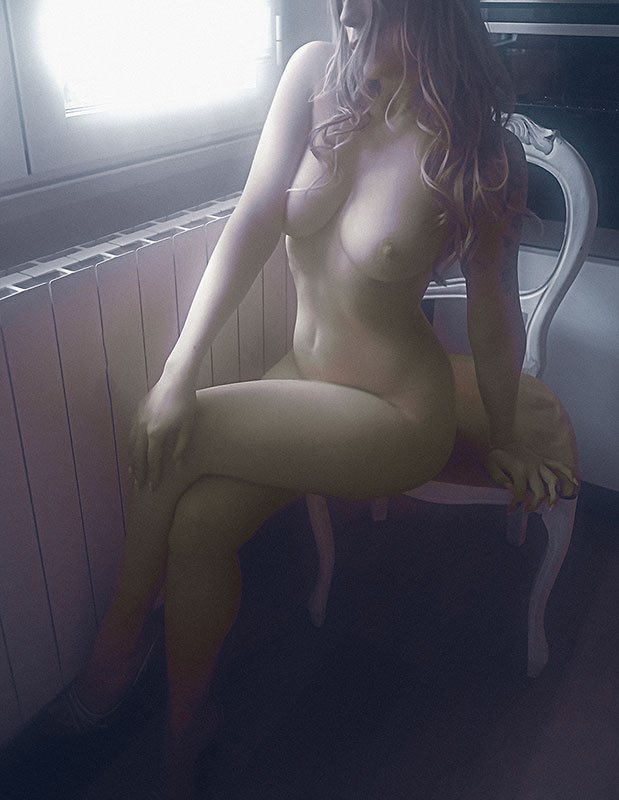
N. by the window 2025; ph: Francesco Coppola
Reading about and looking at this author's images provokes in me a bit of vertigo. What a world was his, yet difficult and hard — how would any of us have fared during the Great Depression or during WWII? He always had to be very careful about how he spent his money, but nevertheless his efforts went toward exploring and expanding photography's possibilities and boundaries.
I feel now how much smartphone photography has trivialized the act of photographing. In Weston's time, it was as big as an 8×10 film sheet; now it's as little as my iPhone 13 mini screen.
Fortunately, there are still museums, exhibitions, big — oh so very big! (Wait until I talk about my favored fashion photographer Paolo Roversi!) — printed images where the magic of photography is still alive and can catch you and carry you away with it!
I invite you to go visit those museums of modern art, photography exhibitions. You can't say you have sharp eyes until you've exposed yourself to printed images!
That is all for today!
Shine on!
Per aspera ad astra!