
Transitional Authors 4: Harry Callahan
Foreword
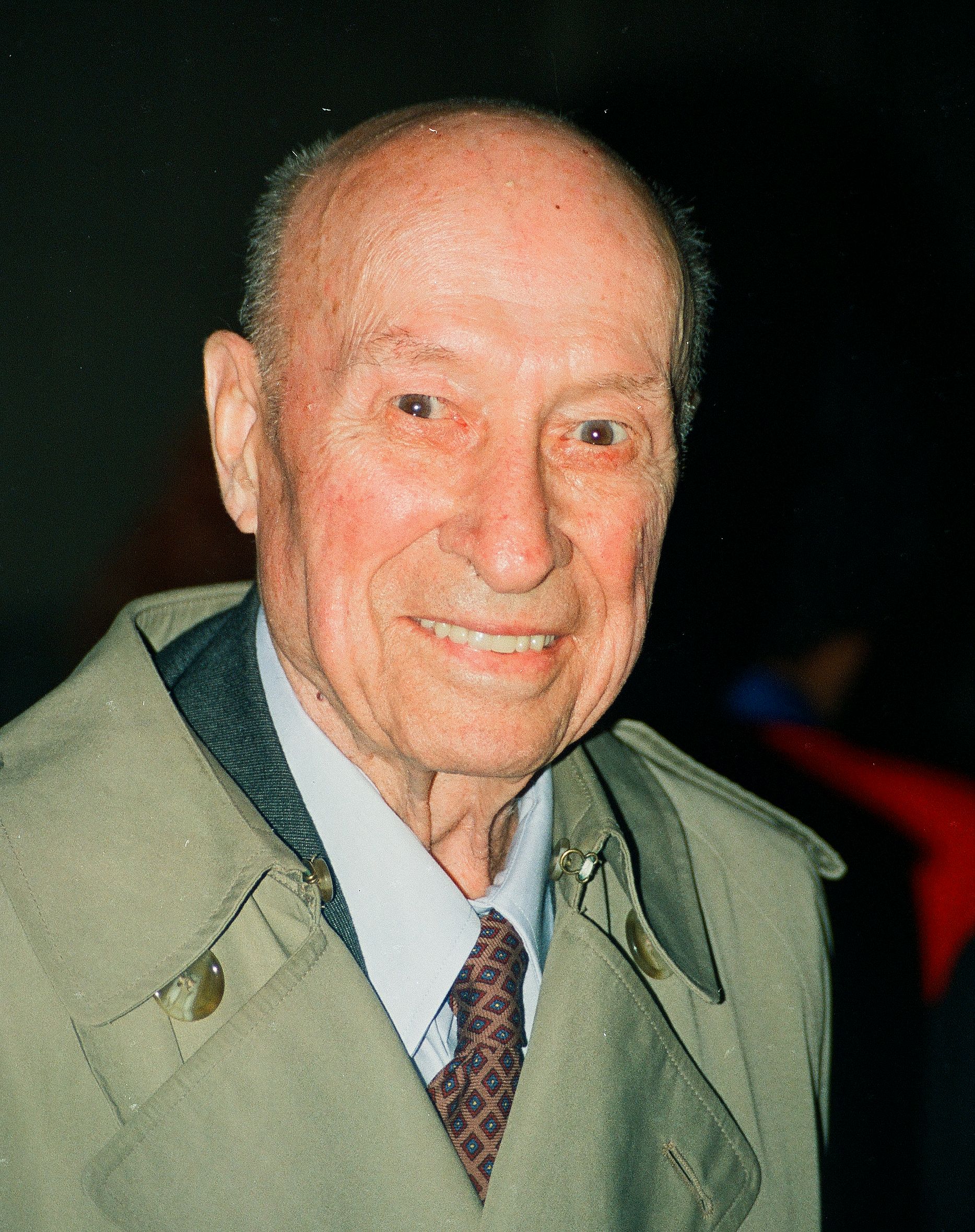
Harry Callahan portraied by John Mathew Smith
Ciao! Today I present another fascinating artistic photographer whose career and approach to the medium truly resonate with me. Today's subject started as a self-taught photographer and became an influential teacher at both the Institute of Design at the Illinois Institute of Technology and later at the Rhode Island School of Design. He should be cherished by any enthusiast, beginner, or passionate but not-yet-professional photography practitioner.
But it is how he operated, the choices he made, and above all his artistic nude work with his muse Eleanor — his wife — that struck the right chords with me. With no further ado, let's dive into his biography.
Biography + Career
Harry Callahan was born in Detroit, the American capital of car manufacturing, in 1912. There he grew up and began working at Chrysler in the parts department. In 1933, he met his future wife Eleanor Knapp on a blind date (she was working as a secretary in the same car company). It took them 3 years to get married. In 1938, Callahan joined the Chrysler camera club and started learning photography. Inspired by a lecture from Ansel Adams that he attended in 1941, he decided to take his passion for photography seriously.
Harry Callahan bio and work by Ted Forbes at The Art of Photography youtube channel.
In 1946, he was invited to teach photography at the Institute of Design in Chicago by László Moholy-Nagy, the Hungarian Modernist photographer and painter. Though he taught there and later at the Rhode Island School of Design (from 1961 until his retirement in 1977), there are no written scripts from him about photography theory. Instead, he guided his students by example, inviting them to turn their cameras on their own lives — exactly how he operated in this field.
Throughout his active life, Callahan maintained a remarkable custom: he would shoot every morning, edit the photos in the afternoon, but finalize his work for only six images per year. This disciplined activity revolved around the center of his life — his wife Eleanor, whom he photographed from 1947 to 1960, either dressed or naked, indoors or outdoors, in black and white as well as in color. Alongside his family images, he photographed the scenery around where he lived and the places they traveled to when they could afford it.
Callahan, while very accurate in his compositions and guiding lines, experimented extensively with double or multiple exposures. Thus, even though his images were well focused, clean, and well composed like the f/64 approach, his work was experimental and aimed at expanding the medium's narrative capabilities. He merged Ansel Adams' purism: sharp focus, full tonal range, clean prints, with Moholy-Nagy's experimentalism to create something entirely his own.
In 1956, he received the Graham Foundation Award, which allowed him and his family to spend a year in southern France, where he took many photographs. In 1978, he represented the United States (together with painter Richard Diebenkorn) at the Venice Biennale. This was in addition to the many exhibitions he had in the USA and France, including a major retrospective at the Museum of Modern Art in New York in 1976/1977.
Due to his daily practice approach to photography, after his death Callahan left behind a collection of 100,000 negatives and more than 10,000 proof prints. Many of his pictures are kept at the Center for Creative Photography at the University of Arizona in Tucson.
Eleanor: A Muse, A Focus Point, An Engine of Photographic Improvement
Eleanor, the photobook by Harry Callahan as showed by Photobook guy channel on youtube.com
Let us put aside — for a moment — the extraordinary speed of his career success, being able to pass from a self-taught photographer to a teacher in a Design department of a Technology Institute in only eight years. This was a sign, probably, of easier times in general sense: the II World War did end short time before and the western economies started to booming, better times for the photography medium that was developing with better gear and chemical emulsions, progressing towards growing attention and recognition from the general public and institutions. This would lead shortly to the start of the Golden Era of Fashion Magazines and the Supermodel era — and yes, his practice and tale happened on blessed USA soil from the 1940s to the 1970s, not in the self-devastated Italy of 2025.
But consider this: practicing every day, shooting in the morning, developing in the afternoon, with a wife who willingly posed for him with trust and love, allowing him to exercise, experiment, and improve day after day, week by week, month by month. Indeed, his nude work is always a study — not only of leading lines, rule of thirds (which he could happily break very often), and expositions — but also of shapes, human condition, intimacy and relationship.
We can admire Eleanor very close, backlit while leaning naked on the family bed, as well as very distant, very small, atop a little elevation of terrain. We see her dressed on the streets of their neighborhood, but often (though not always) central — signaling, to my eye, her foundational importance.
He experimented with double exposures, overlaying geometric patterns on her nude body. He printed in extreme contrast, transforming their sparsely furnished apartment into fields of black that isolated her form. The nudes were intimate but never sexual, always respectful of her privacy and autonomy. Another time like I wrote for my patrons last Monday: the often demonized “male gaze” goes wide and beyond what certain people lament.
Eleanor appeared in his photographs even before their daughter Barbara was born — in pregnancy photographs. From 1948 to 1953, Eleanor and sometimes Barbara were shown out in the landscape as tiny counterpoints to large expanses of park, skyline, or water.
If Callahan evolved so fast, becoming a photography teacher at university level (in 1940s USA, I remind you), it is in large part thanks to her too.
Conclusions
Once again (after Clergue, Brandt and Friedlander), I feel close to a photography author. How come? Why?
I went from landscape and local wildlife photography self-taught practice to portrait and fashion study and practice after the end of my 11-year relationship, after my father's death from Alzheimer's, and with a lifelong yearning for the kind of partnership Callahan and Eleanor shared. Callahan's experience is simply a dream that I've held seemingly all my life: a successful career with a loving partner who stood by and helped me throughout.
In the age of "we are searching for young candidates with working experience" bullshit, in a place where creative careers seem concealed in misty notions like: maybe after ten-thousand-euro academies, or a specific university course — could a self-taught route still work? And again, when relationships seem fragile in the era of right-swipe gestures on smartphone apps, during this freezing natality winter crisis, oh how dear and near to my heart it is to acknowledge this photographer's life and work!
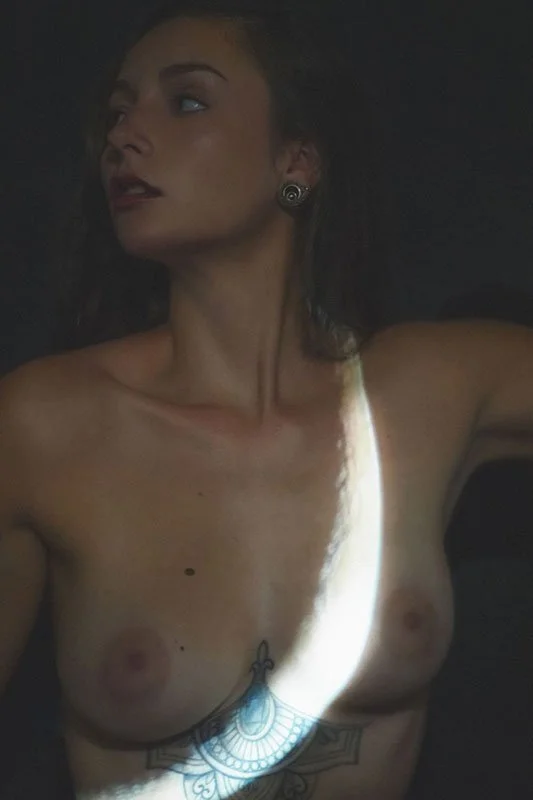
Fabiola Pietrasanta and the moon; ph: Francesco Coppola
We surely live in another time (not to mention place), but what can this distant photographic experience say to us?
Maybe — yet again — that rules are secondary to narrative intent.
Possibly that, given some basic level of skill, motivation and sensitivity, constant practice over enough time allows a photographer to reach high levels of expertise, even reaching the artistic quality that will bring them to represent their country at international art events around the world.
Surely: Art continues to be the polar star of photography's survival.
This author’s life shows another time the truth of the old Italian navy motto: Through hardships to the stars.
Shine on!