
Transitional Authors 3: Lee Friedlander
Foreword
Eclectic photographer like few others Lee Friedlander started early shooting and earning some money and until the end of his life he captured quite everything involving human subjects and their environment, like i.e.: signs and monuments.
Here we focus on the Art Nude work of an Image Author, but in his case is not possible to understand his nudes if we do not delve, before, in his general life and other works he made.
Biography + works
Born in Aberdeen Washington on July 14th 1934 Lee Friedlander had his first commission work at 14 years old, when he was asked to make a photo of a dog to use for a lot of personalized greeting cards, but when he turned 18, he studied properly Photography at the Art Center College of Design in Pasadena after which he transferred in New York in 1956.
JoelUlises discusses and shows Lee Friedlander on his YouTube channel: https://www.youtube.com/@Joel_Ulises
There he frequented the jazz and blues clubs where he started portraying the musicians and his images were so good that soon he started to be commissioned to make portraits of musicians for their album covers reaching one of his first heights in his photographic career.
After this he started practicing what now would be called Street photography and at the time it was identified as social landscapes. He was a prolific photographer, obsessed with the medium and conducting over time various projects at the same times.
He depicted people on the streets, mannequins in the store fronts, signs, monuments gaining already in 1960, his first (of 3) inductions into the prestigious Guggenheim fellowship, even if his work has always been difficult to interpret.
At the beginning he was accused of producing only unstructured snapshots, later instead the accusations have been of being to cerebral and difficult to read. He was also a photographer without a particular pre-imposed meaning, because his photography came (like mine) after the shot, more than this, after several starting shots that were intended only to focus on the moment.
More important, his images show often a painterly quality, obtained by shooting with a pretty closed lens aperture so that everything captured on the street appeared flat and in focus. So, then he worked in juxtapositions, layered, where the subjects were often obscured by something else, or put on the periphery of the frame. All this leaving the viewer the task to interpret his images.
To my eye, he represented in his photography the complexity of reality in his mix of mundanity and beauty, sometimes grittiness, sometimes fun and ironic, obsessive or forgetful.
He obtained the Guggenheim grants in 1962 and in 1977. In 2005 MOMA made a big retrospective with his photos from 1950 inward. In the same year he received the Hasselblad International Prize and the before mentioned retrospective of his work has been exhibited in 2008 at San Francisco Museum of Modern Art.
As for the gear he used, he transitioned from a 35mm Leica to a Hasselblad system to explore the square frame format without keeping boxed his creative work in one system for too long.
The Nudes and The Nudes: A Second Look
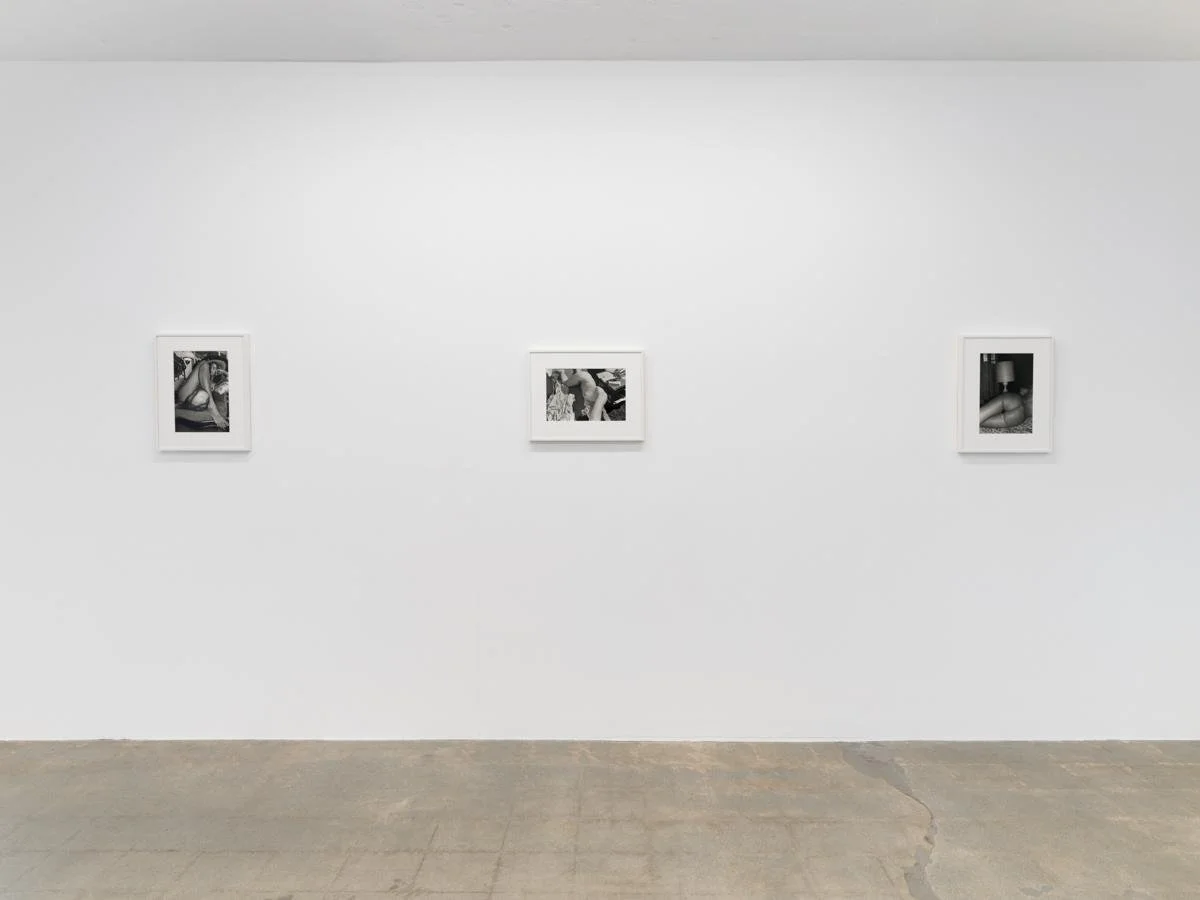
Castel gallery’s exhibition about Lee Friedlander’s nudes visible at https://thecastle.la/lee-friedlander
And – at last – we arrive at his nude works. In this genre he produced two books, The Nudes and the later and with more images The Nudes: A Second Look.
In this genre we can see the same principles used for his other works applied here. The subject appears in a whole variety of compositions: very close and depicting limbs or thighs or the full body, plainly in sight and exposing – with a natural spontaneity – all that can be seen, without the concern many photographers have about concealing intimate parts. Not always, but often the subject is obstructed by in-house day-to-day life or put at the periphery of the frame.
There is no idealization of women’s beauty and body. In his model shoot with a student Madonna (the famous pop star) published in a Playboy issue during 1985 she appears in her apartment (as Friedlander usually liked to shoot) and – yes – nothing is hidden, her beauty, sure, but also the hairs on her legs, various angles of her body in a complete investigation of model’s youth, more pleasant or less, sexy at times, and fragile or crude in others.
In his nude work he used sometimes natural light, in others flash lighting, but shooting in New York I suppose that the Sun is not always available like in the hot Los Angeles area or in Miami, so that the use of flash could have been a necessity more than a visual exploration.
Conclusions
Lorih Caradonna in our last model shoot; ph: Francesco Coppola
So, the complexity of reality is always there, the enigmatic nature of it as has been for the Surrealist, but instead of trying to overcome it with psychological interpretations, pre-formed ideas our author decided to start from what the reality is, what caught his eye, summing in a series of images all the aspects of human appearance and condition.
He surely has been unconventional and engaged in pushing the expressive capabilities of the photographic medium.
The next time at an art nude workshop the master photographer tells me “Don’t shoot the intimate parts” I will ask him: “What about Friedlander?”
Even if his approach is not mine – surely, I resonate more with the Surrealist movement, due to my whole layered life conditions – I feel now refreshed after having explored his work. Variety is a blessing.
Another impression I have from his life and career is that he acted in opposition to the idea that “in order to grow and have success as a photographer you have to focus in one genre”, that could be inspiring but only if you don’t contextualize his era and ours.
Our times are more complex and difficult to live and operate in. Being a jack of multiple trades in photography I doubt that could work today, when you cannot show photos of your house cat, together with wedding photography and maybe fashion photography without being perceived as an amateur.
The obstacles are many: AI imagery, post-reality culture, attacks on science, the demonization of men appreciating women's beauty.
Nah! Art photography is the one and only answer for the landslide I feel we are living in, of that I am still certain.
That’s all I have for you this week.
Shine on!
Per aspera ad astra