
Transitional Authors 7: ANDRÉ KERTÉSZ
Introduction
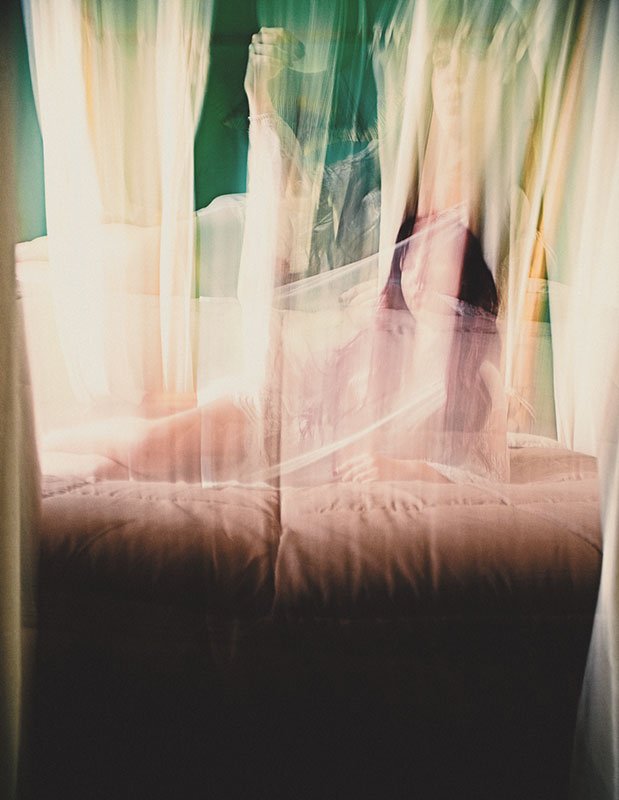
Asia Puopolo, doubled; ph: Francesco Coppola
After the many American photographers treated in this series of article it is time to talk about some European one. This time I am presenting you a Hungarian born figure that had a very difficult and contrasted start, and development I might add, in the photographic medium, but that with passion and endurance he finally reached a worldwide artistic recognition, “the little soldier” of the medium that worked hard without an initial recognition and left, for us interested in art nude photography, a very important work about self perception a theme that in our social media era is very actual and important.
Early Life and the Hungarian Period (1894-1925)
Andre Kertesz, from 3squinas Fotografia youtube channel
André Kertész's path to photography was unconventional. His father, Lipót Kertész, was a bookseller who died of tuberculosis in 1908, leaving young Andor without a father figure at age fourteen. His mother Ernesztin's brother, Lipót Hoffmann, stepped in to support the family, eventually paying for Andor's business education at the Academy of Commerce.
Despite graduating in 1912 and securing a position at the Budapest stock exchange, Kertész felt no calling for finance. His true passion lay in the illustrated magazines he devoured and in the pastoral landscape surrounding his uncle's country property in Szigetbecse, where he spent time fishing and swimming in the Danube. That same year, 1912, he purchased his first camera over his family's protests, and began photographing the local peasants, Romani people, and the Hungarian Plains. His first photograph, Sleeping Boy, Budapest (1912), marked the beginning of a visual journey that would span over seven decades.
By 1914, his distinctive mature style was already evident. During WWI after a brief service in the Austro-Hungarian service he ended wounded. During his convalescence in Esztergom, he created Underwater Swimmer (1917), exploring bodies distorted by water — an early glimpse of themes he would revisit in his Distortions series.
His photographs were first published in 1917 in Érdekes Újság magazine. After the war, he returned to the stock exchange where he met his future wife, Erzsébet Salomon (later Elizabeth Saly), who also worked there and would become his lifelong muse and model.
The French Period: Recognition and Innovation (1925-1936)
In September 1925, Kertész emigrated alone to Paris — then the artistic capital of the world. He changed his first name to André and immersed himself in the city's vibrant bohemian culture, settling in Montparnasse among a community of Hungarian expatriate artists including László Moholy-Nagy, Brassaï, and Robert Capa.
Paris proved transformative. In 1927, Kertész became the first photographer ever to have a solo exhibition when Jan Slivinsky presented thirty of his photographs at the Sacre du Printemps Gallery. The Dadaist poet Paul Dermée dubbed him "Brother Seer" — a perfect metaphor for Kertész's unique vision.
During this period, he created iconic portraits of Piet Mondrian, Marc Chagall, Colette, and Sergei Eisenstein. In 1928, he switched from plate-glass cameras to a Leica, and his innovative street photography with the 35mm camera became extremely influential. He worked extensively for Vu magazine under editor Lucien Vogel, who gave him freedom to create photo essays on diverse subjects. His work also appeared in Art et Médecine, Le Matin, Frankfurter Illustrierte, and The Times of London.
In 1933 came one of his most controversial and celebrated projects: the Distortions series. Commissioned by a publication, Kertész photographed approximatively 200 images of two models, Najinskaya Verackhatz and Nadia Kasine, nude and reflected in carnival-style distortion mirrors. Some images appeared in the "girly magazine" Le Sourire and in Arts et métiers graphiques, while others were published that same year in the book Distortions. The series represented a radical exploration of form, perception, and the human body — themes that resonated with the Cubist and Surrealist movements surrounding him.
Kertész finally married Elizabeth on June 17, 1933, shortly after his mother's death. During the French period, he also published several books: Enfants (1933), dedicated to Elizabeth and his mother; Paris (1934); Nos Amies les bêtes (1936); and Les Cathédrales du vin (1937).
The American Period: Struggle and Perseverance (1936-1962)
As Nazi power grew in Germany and antisemitism spread across Europe, Kertész and Elizabeth made the difficult decision to emigrate to the United States. Despite his hopes of finding success in the new nation, it is undeniable that this was a necessity-imposed act that interrupted his customary life in the bohemian Paris, forcing him to learn yet another language – one with which he had to fight for a long time, and ending up famous for speaking a mix of Hungarian, French and English his very own tongue the so called “Kertészian”.
Thus, the starting American period proved far more difficult than imagined. When he approached Beaumont Newhall at the Museum of Modern Art with his Distortions photographs, Newhall criticized them, though he did exhibit five in the groundbreaking 1937 show Photography 1839-1937. But his first New York solo exhibition came in December 1937 at the PM Gallery.
Work for magazines like Harper's Bazaar, Vogue, House and Garden, and even Life proved frustrating. At Life, when he photographed beyond his assigned tugboat subject to capture the entire harbor's activities, the magazine refused to publish the unauthorized images, resenting what they saw as disobedience but what Kertész saw as creative curiosity.
In 1941, Hungary's alliance with the Axis powers led US authorities to designate the Kertész couple as "enemy aliens." André was forbidden from photographing outdoors or working on anything related to national security. He essentially disappeared from the photographic world for three years. They became US citizens in 1944 — Elizabeth on January 20, André on February 3.
In 1945, Kertész published Day of Paris, featuring photographs taken before leaving France. The book received critical acclaim. In 1946, he signed an exclusive contract with House and Garden worth at least $10,000 annually — financially stable but artistically restricting work. Over the next sixteen years, the magazine published more than 3,000 of his photographs. Despite this professional success, Kertész felt creatively starved, with little time for personal work.
A bright spot came in 1946 when the Art Institute of Chicago gave him a solo exhibition featuring his Day of Paris series — an event Kertész cited as one of his finest moments in America and the first time he felt he received genuinely positive reviews. Yet when Edward Steichen curated the famous 1955 Family of Man exhibition at MoMA, Kertész was excluded — feeling deeply stung.
The International Period: Recognition at Last (1962-1985)
In 1961, after a minor dispute, Kertész broke his contract with Condé Nast Publishing and returned to personal work. This marked the beginning of his "International period" when worldwide recognition finally arrived.
The transformation came in 1964 when John Szarkowski, the new photography director at MoMA, gave Kertész a solo exhibition. Critical acclaim followed, and suddenly Kertész was recognized as an important artist. Exhibitions multiplied globally: Venice (1962, 1963 — where he received a gold medal), Paris at the Bibliothèque nationale (1963), and throughout the world into his early nineties.
Awards accumulated: Guggenheim Fellowship (1974), Commander of the French Ordre des Arts et des Lettres (1974), Mayor's Award of Honor for Arts and Culture in New York (1977), Medal of the City of Paris (1980), honorary doctorates from Bard College (1981) and the Royal College of Art (1983), and Chevalier de la Légion d'Honneur in Paris (1983) — which came with an apartment for future visits. In 1984, the Metropolitan Museum of Art purchased 100 prints, its largest acquisition from a living artist.
In 1979, Polaroid gave him an SX-70 camera, with which he experimented throughout the 1980s, creating color photographs that represented pure experimentation and curiosity — warm or cold tones captured through the same masterful compositions and perspectives that defined his black-and-white work.
After Elizabeth died of cancer in 1977, he traveled extensively for exhibitions, especially in Japan, and rekindled old friendships.
Kertész died peacefully in his sleep at home on September 28, 1985. His ashes were interred with Elizabeth's.
Photography approach and philosophy
BBC Interview and documentary of Andrè Kertész from Everything has its first time youtube channel
Despite decades of recognition and honors, Kertész never felt he had achieved the worldwide acceptance he deserved. His influence touched Robert Capa, Brassaï (who counted him as a mentor), and countless contemporary photographers in the 1960s and 1970s. Today he is considered one of the seminal figures of 20th-century photography and often called the father of photojournalism.
His work demonstrated that a photographer must know not only what to shoot, but also what not to shoot — a lesson in restraint and artistic integrity that remains timeless.
He had always won some publications and important exhibitions, but his struggles with English language and his philosophy that images have to speak for themselves kept him distant to the major publications of his time and that hurt him, before the final, international, acclamation.
Adhering to a view where there is wonder and significance in the common, every day, life with no need of higher socio-political cultural fight to take didn’t help either, even if this approach to photography has been shared by various other great masters of the genre that we have already met in our journey in this Photography History series.
Kertész prized emotional impact over technique, famously stating: "I just walk around, observing the subject from various angles until the picture elements arrange themselves into a composition that pleases my eye." He also said, "I write with light." His work combined photojournalistic interest in movement and gesture with formalist concern for abstract shapes, making him historically significant across all areas of postwar photography.
Conclusions
Polaroids from André Kertész from The Art of Photography by Ted Forbes youtube channel
Mostly known for his photojournalist images, our hero of the day shot nudes along his life, even in his late years, when he was gifted with a Polaroid SX-70 instant cameras we have some beautiful examples of his compositions in color of nude subjects.
Yet his 1933 work Distortions demonstrates to be of great importance even in our social media times. Oh surely, world issues have flooded our minds. Media seems to have forgotten the struggles of so many of our youth with the perception of self, afflicted by the over perfection of models on Instagram and the consequent spreading of cases of bulimia and anorexia, self-harm, bullying and the ever-continuing stream of lack of self esteem of too many others.
After all, this work was highly praised by the surrealist movement, and – to my eye – it is surrealism itself to have returned in contemporary relevance.
Kertész suffered to be recognized because he has been focused on everyday life, without falling into the “homo-novus” fever dreams, or other major cultural fights, but what do you think real life is?
Artists like him (and if I succeed, I will add my voice in this regard), shows that there are people struggling even with life facts that to others are simple, if not trivial. But are you really sure that if you expose yourself on the Kertész mirror your image would appear plain and simple and not distorted in some way?
Maybe one of the artist’s fights there is this task to accomplish too, day to day life is wider, deeper and more nuanced than insensitive people think.
That is all for this time.
Shine on!