
Into the Jaws of Commercial Photography – Helmut Newton
Biography
Helmut Newton was born Helmut Neustädter on 31 October 1920 in Berlin, into a Jewish family. Newton developed his passion for photography early — he bought his first camera at twelve — and in 1936, at sixteen, he began a formal apprenticeship with Yva, the Berlin photographer Elsie Neuländer Simon, who specialized in portraits, fashion, and nudes. It was a formative education in every sense.
Helmut Newton: The Bad and the Beautiful | Official Trailer | from DocPlay youtube channel
The events of Kristallnacht in November 1938 ended with Newton briefly interned; the family understood it was time to leave. He obtained his passport just after turning eighteen and departed Berlin in December 1938, boarding a ship at Trieste alongside roughly two hundred other refugees. The intended destination was China, but Singapore offered a foothold, and he stayed — working briefly for the Straits Times and then as a portrait photographer.
The respite was short. In 1940 British authorities interned him as an enemy alien and transported him to Australia. He was held at a camp in Tatura, Victoria, before being released in 1942. He picked fruit in Northern Victoria, then enlisted in the Australian Army, serving as a truck driver until the end of the war. In 1946 he became an Australian citizen and changed his name to Newton. Two years later he married the actress June Browne, who would become his lifelong companion, collaborator, and — under the quietly ironic pseudonym Alice Springs — an accomplished photographer in her own right.
Newton established a studio in Melbourne's Flinders Lane and built a solid reputation in fashion, theatre, and industrial photography during the affluent postwar years. Recognition came progressively: a commission for an Australian Vogue supplement in 1956 led to a twelve-month contract with British Vogue, and Newton left for London in 1957. The fit was uneasy — London's more restrictive editorial climate sat poorly with his instincts — and he departed before his contract ended, gravitating toward Paris and the continental European magazines that would prove far more receptive to his vision.
After a return to Melbourne and a contract with Australian Vogue, Newton and June settled permanently in Paris in 1961. He took a position with French Vogue and began developing the style that would make him one of the most discussed and debated photographers of his generation. The fashion industry had never quite seen anything like it.
A heart attack in 1971 interrupted his pace but not his ambition. His wife's encouragement kept him working, and the following decade produced some of his most celebrated series: the stark, monumental "Big Nudes" of 1980, the "Naked and Dressed" portfolio, and in 1992 "Domestic Nudes," considered the pinnacle of his urban-erotic style. He also collaborated with Playboy, producing work that operated with considerably less of the editorial alibi that fashion commissions had provided.
In 1981 Newton and June moved from Paris to Monaco, dividing their time between Monte Carlo and Los Angeles, where Newton wintered annually at the Chateau Marmont — a habit he had maintained since 1957. France honored him with the Grand Prix National de la Photographie in 1990; Germany followed with its Grand Cross of Merit in 1992. A large retrospective for his eightieth birthday in 2000 traveled from Berlin's Neue Nationalgalerie to London, New York, Tokyo, Moscow, and Prague.
In 2003 he formalized the establishment of the Helmut Newton Foundation in Berlin, ensuring the preservation of his archive. On 23 January 2004, he suffered a fatal heart attack while driving away from the Chateau Marmont. He was eighty-three. His ashes are buried in Berlin, the city he had fled sixty-six years earlier.
His Photography
Who is Helmut Newton? From THE MODEL GENE youtube channel
Newton was a notably gear-agnostic photographer, working across many different camera systems and formats, in both black and white and color. His groundbreaking style was erotic and precisely composed, his images marked by sado-masochistic and fetishistic undertones — women who projected power and vulnerability within the same frame, scenarios drawn from film noir, German Expressionist cinema, and surrealism.
He rejected the studio backdrop throughout his entire career, preferring streets, open air, and the lived interiors of real homes and hotels. As he put it himself: "I have always avoided photographing in the studio. A woman does not spend her life sitting or standing in front of a seamless white paper background."
The defining quality of his influential photography was its ambiguity: the tension between the personal agency of his subjects and their simultaneous objectification, leaving the viewer — and perhaps the subjects themselves — suspended between the feeling of being used and the feeling of being served. He consistently subverted prevailing moral and feminist conventions, glamorizing the power dynamics within relationships and exploring fetishes that he considered simply part of the reality of the world around him.
His women were invariably of exceptional, rare beauty — and it was a beauty that belonged almost exclusively to the most privileged social classes of the day. All of this appeared on the pages of European Vogue. That was the temperature and the tone of the 1970s and 80s.
Personal Considerations
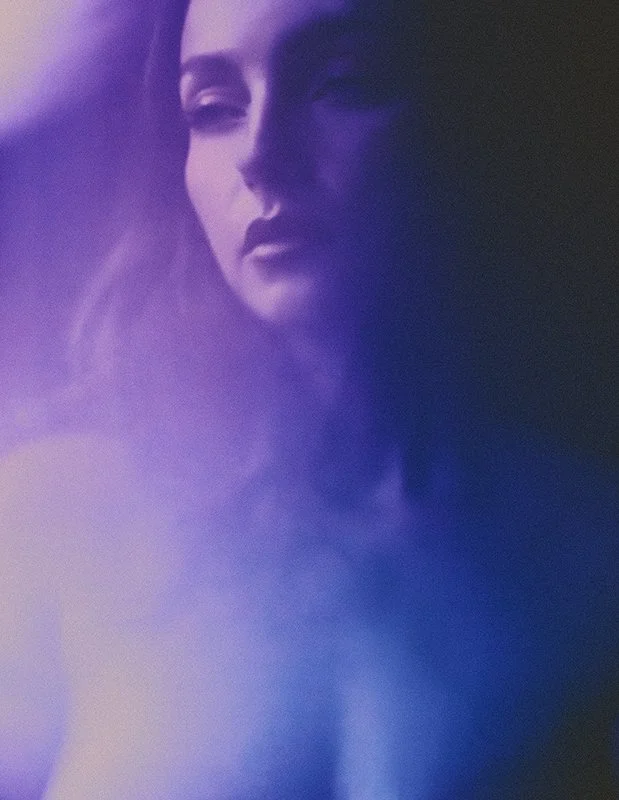
DIY Filtered Matilde; ph: Francesco Coppola
Newton once offered this advice to young photographers: "There are two dirty words in photography; one is 'art,' and the other is 'good taste.” There could hardly be a greater distance from my own approach to the medium. And yet, for a man who claimed no interest in psychology, he turns out to be remarkably readable. Whatever our differences, Newton was an artist to his core — and that is readable across his whole career, in the way he bent the fashion magazine world entirely to his personal vision, as no one before him had done.
Newton lived and worked at precisely the moment and in precisely the place where fashion photography was booming, and where a sufficiently talented photographer could achieve a genuinely luxurious way of life. Commercial photography rewarded him so well that he perhaps never fully perceived the world of photographers who pursued artistic recognition through different and more difficult routes — and what those routes demanded, and what they could ultimately offer, as shown in the previous articles in this series.
That said, to my eye he reads as a quintessentially German photographer: cold and direct in his gaze, his sensibility tempered — certainly — by the Brassaï tradition of nocturnal street photography, and shaped too by his Jewish origins and the brutal power dynamics he suffered as a young man in Germany and in Australia. It is characteristic that he refused to speak about his past; many survivors refused to speak of that burden entirely. But the persistent glamorization of power play in his imagery, staged with those gorgeous models across decades of work, seems to me an unmistakable displacement of internal wounds — a way of revisiting the same terrain, but this time from the other side of the power and changing its nature, from dehumanizing to celebrate the physical beauty of women.
Turning to his nude work specifically, one can explore it across galleries both physical and online, or in surviving issues of Playboy and other magazines, and what strikes you is the sheer variety of his approaches — studio work and location work, sculptural compositions and raw voyeuristic captures, black and white and color. The guiding thread, if I read him correctly, is always provocation: of mainstream morality, of taboo, of the ambiguities of power in intimate relationships — and often with a streak of wit and amusement running underneath, as in the celebrated "The Wife and the Models," published in Vogue Paris in 1980.
This approach has been copied so many times, by so many photographers, that my own instinct now points firmly in the opposite direction. Its endless replication is itself a testament to Newton's impact and influence — but there is simply no point, in 2026, in continuing these particular provocations. The well has run dry.
The social context has shifted too profoundly. There are only so many taboos and conventions available to transgress, and the decades between Newton's heyday and today have exhausted most of them. More fundamentally, the world his imagery inhabited — one of sleek privilege, sexual freedom as an elite lifestyle, the glamour of power exchange among the beautiful and the wealthy — is increasingly disconnected from the lived reality of the majority.
Building a family in the traditional sense has become a status symbol affordable only to the few. The many are under-employed or precariously employed, thus couples fracture at accelerating rates and the old model of couple life is perceived now not as a convention to subvert, but as an unreachable dream.
Between fetishes and romantic love, there remains the basic psychology and physiology of human beings, men and women alike. The real task for anyone who has something genuine to say about the contemporary human condition is to find a balance — to speak about actual lives rather than to an idealized world of limitless possibility that no longer exists for most people, if it ever truly did.
Women, truly, don’t live standing on their feet or seated in front of a white wall, at the same time they are neither angels nor demons. The question of whether they remain interested in a shared life project — and under what conditions, and at what cost — is one that the glossy provocations of the 1970s and 80s never needed to ask.
In this landscape, Newton's imagery is a distant star — cold, brilliant, and belonging to a sky that has since changed beyond recognition. We can admire it for what it was, and then press forward.
Shine on.
Per aspera ad astra.