
Biography
Who is Irving Penn? on THE MODEL GENE YouTube Channel
Born on June 16, 1917, in Plainfield, New Jersey, Irving Penn came from a Russian Jewish emigrant family. His formation was rooted in the visual arts broadly — at the Pennsylvania Museum School of Industrial Art in Philadelphia, where he studied drawing, painting, graphics, and industrial design under Alexey Brodovitch, the formidable Bauhaus-influenced émigré who would also shape the vision of Diane Arbus and Garry Winogrand. That training gave Penn something most photographers of his generation simply did not have: a craftsman's instinct for the relationship between image and printed page.
His entry into photography was almost accidental. After graduating in 1938, he spent several years working as a freelance designer before leaving to spend a year painting in Mexico and across the United States — testing whether painting was his true calling. It was not. Returning to New York, he joined Vogue magazine's art department under Alexander Liberman. When Penn began suggesting cover ideas that nobody else could quite execute, Liberman's solution was simple: hand him a camera. His first professional photograph became Vogue's first color cover, appearing in October 1943. He was twenty-six years old, and he had found his medium.
Before he could truly establish himself, the war interrupted. Penn volunteered with the American Field Service, driving an ambulance in Italy through a brutal winter campaign with the British Eighth Army, then transferring to India in 1945. He returned to New York in late 1945 having seen a great deal of the world at its most raw — an experience that would quietly inform the democratic curiosity he later brought to photographing everyone from Picasso to Andean villagers with the same focused, respectful attention.
Back at Vogue, Penn met the Swedish fashion model Lisa Fonssagrives — considered by many the first true supermodel — and married her shortly after. Together they built, from the late 1940s onward, one of the most quietly powerful creative partnerships in the history of the medium, she was frequently the subject, he always the eye behind the camera. In parallel, Penn was constructing what would become one of the most sustained and productive relationships between a photographer and a magazine ever recorded — spanning more than six decades at Vogue.
In the early 1950s he founded his own independent studio in New York, famously declaring that "photographing a cake can be art," and began taking on advertising clients alongside his editorial work. Over time that client list grew to include names like Issey Miyake and Clinique, campaigns that became as iconic in their own right as his magazine work. "Penn shows me what I do," Miyake would later say — perhaps the most precise compliment any photographer has ever received from a collaborator.
The 1960s brought new assignments and new freedoms — portrait essays, ethnographic travels, subculture documentation. But the following decade was harder. Commissions dried up, his immaculate Fifth Avenue studio had to close, and Penn found himself making television commercials to sustain his household. It was a humbling interlude for a man of his stature, though characteristically he spoke about it without self-pity, framing it simply as professional responsibility. He endured it, and emerged with his vision intact.
He continued working with exceptional energy well into the twenty-first century, producing some of his most celebrated images long after most photographers of his generation had stopped. He died at his Manhattan home on October 7, 2009, at the age of ninety-two.
The Photographer
Irving Penn a retrospective, from TRT World YouTube channel
What separated Penn from his contemporaries was not any single technique or innovation but rather a total coherence of vision — one that was already fully formed, in its essentials, the moment he picked up a camera, because it had been built up through years of working in the graphic arts.
Where the dominant fashion photography of the postwar era relied on elaborate artificial lighting and busy, theatrical staging, Penn stripped everything away. He placed his subjects against plain grey, white, or black backdrops and worked almost exclusively in natural studio light — giving him complete control over tonality while achieving an effect of radical simplicity that felt, paradoxically, both timeless and urgently modern. He was among the first photographers to use this approach systematically, and its influence on fashion photography ever since is incalculable.
Later he developed a variation on this: a set of angled backdrops forming a tight, almost claustrophobic corner into which subjects were placed — a device that introduced a subtle psychological pressure into the image, making even relaxed sitters appear somehow concentrated, distilled into their own essence.
His portraiture applied the same logic. Rather than catching his subjects in motion or off-guard, Penn compressed them — literally and figuratively — into a confrontation with the camera that revealed the essential. The results form a visual archive of extraordinary range: Picasso, Colette, Francis Bacon, Miles Davis, Georgia O'Keeffe, Marcel Duchamp. When we picture many of the defining cultural figures of the twentieth century, we are often, without knowing it, seeing them through Penn's eye.
Technically, Penn operated at a level few photographers have matched. His background in graphic design gave him an unusually sophisticated understanding of how a photographic image would ultimately be reproduced — on the magazine page, in the advertisement, in the exhibition print — and he worked backwards from that understanding at every stage.
From 1964 onward he devoted enormous energy to reviving and perfecting the platinum printing process, an antiquated nineteenth-century technique capable of rendering a far wider and subtler range of tones than conventional silver printing. The process demanded large-format negatives, hand-coated papers, and painstaking multiple exposures, and Penn approached it with the methodical precision of a craftsman-scientist, borrowing registration techniques from the graphic arts to achieve the alignment accuracy the process required. His investment in platinum printing transformed its status — from historical curiosity to the gold standard for museum-quality photographic prints.
That same seriousness extended to his still life work, where he brought to consumer objects and perishables the kind of dignified, forensic attention previously reserved for Old Master painting. His series on cigarette butts — begun in 1972, first exhibited at MoMA in 1975 — was a characteristically Penn-ish gesture: finding the monumental in the discarded, the memento mori in the detritus of the street, and presenting it with such formal beauty that the art world, somewhat grudgingly, had no choice but to take notice.
Penn's eye had been shaped early by his admiration for the fifteenth-century Italian painter Paolo Uccello — an artist famous for his obsessive mastery of perspective and his ability to make flat surfaces feel charged with spatial tension. Something of that influence never left Penn's work: the emphatic angles, the precise control of depth, the sense that every element in the frame has been placed there by an intelligence that understands exactly what it is doing and why.
Irving Penn's Artistic Nudes
Irwing Penn, “Earthly Bodies” book review, by
Photobook club with Alex Blanco on YouTube
The towering importance of Penn in commercial and fashion photography risks overshadowing the other, more intimate artistic territory he consistently explored throughout his career. It is worth remembering that before his stable collaboration with Vogue he had already attempted the painter's path — and though he ultimately recognized that brush and canvas were not his instruments, the artist's eye and sensibility remained. They simply found a different outlet.
This is why, from 1949 to 1950, Penn undertook his first serious studies in nude photography, works inspired by the example of Edward Weston and Bill Brandt — two masters who had each, in their distinct ways, demonstrated that the photographed body could carry the formal and emotional weight of sculpture or painting. Penn's early nudes were printed using complex processes that gave the final image the texture of crinkled rice paper; years later he would return to reprint many of them using his recovered platinum-palladium technique, achieving results that gave the figures the cool, timeless quality of carved stone. For a photographer still finding his footing in the professional world, these were remarkably evolved works.
The reception, however, was not encouraging. Those around him — including figures connected to the institutional art world of the time — advised against pursuing this direction further. And so, Penn did what the circumstances demanded: he boxed the work up and waited.
He waited for professional authority. Through the 1950s and 1960s, as his reputation in fashion and portraiture became unassailable, he accumulated something more valuable than fame — the contractual power and artistic freedom to eventually work entirely on his own terms. When he returned to nude photography from the 1970s onward, the conditions were entirely different. His earlier work had embraced what might be called a democratic vision of the body — women of all kinds, thin or plump, photographed with equal seriousness and attention. His later work, by contrast, drew on the world he now inhabited professionally: he photographed the top models of his era, figures whose bodies were already cultural objects of a particular kind, and transformed them into something else entirely. Kate Moss, Giselle Bündchen and others passed through his studio and emerged, in his prints, as classical forms — presences more sculptural than biographical. In those images, the models are statues with a soul.
It is telling, and not coincidental, that this body of work remains almost entirely absent from video platforms like YouTube. Search for Penn's artistic nude sessions and the results are effectively quite blank — while his fashion work is extensively documented and discussed.
Despite certain art nude set of legendary status with top model like Kate Moss, This kind of work exists, celebrated in gallery spaces and museum collections, but the platforms that shape contemporary visibility have rendered it functionally invisible. The contrast says less about Penn than it does about the cultural contraddictions of our own moment.
In this light, Penn can be understood as the last of the transitional figures in the history of nude art photography — the final major author to move between a genuinely free, art-focused engagement with the nude figure and the increasingly structured world of commercial fashion imagery, carrying something of the former's seriousness into the latter's domain.
Personal Conclusions
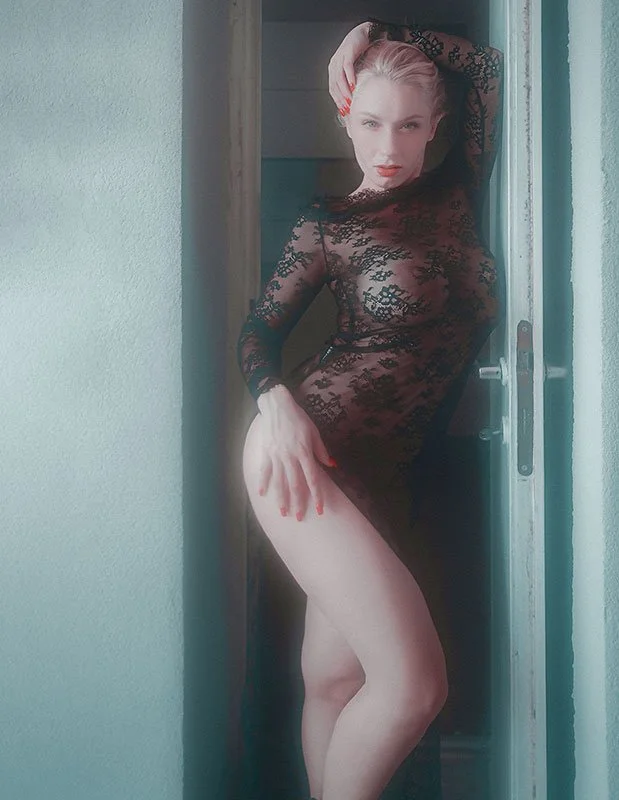
Lorenza veiled view; ph: Francesco Coppola
Penn's story offers an instructive, if not entirely comfortable, mirror for photographers working today. He began from a relatively advantaged position — trained rigorously, connected early to the right institutions — and yet still had to subordinate his most personal artistic ambitions to the demands of professional survival for decades, waiting until his commercial authority was beyond question before he could work freely in the territory that mattered most to him. The nude work that is now treated as a serious contribution to art photography spent years in boxes.
For photographers entering the field now, the structural challenges are different but, in some ways, more acute. Fashion photography as an industry remains commercially robust, but the jobs within it are increasingly threatened by AI generative tools, compressing the space available to newcomers while established masters with long-standing client relationships continue to occupy the upper tier. The ladder that Penn climbed, slowly and with discipline, has fewer rungs than it once did.
What remains available — and what Penn's trajectory quietly suggests — is the artistic route taken first rather than last. Developing a personal technique and vision, contributing to publications, pursuing gallery exposure through open calls and juried selections, building a presence online not as a platform for virality but as a space for the careful sale of prints. It is a slower road, and a harder one. But it is the road that remains.
Shine on.