
Early Years and Formation (1883-1910)
Portrait of Imogen by Meg Partridge on The mirrorless man youtube channel
Born in Portland, Oregon in 1883, Imogen Cunningham found her calling in 1901 when she mail-ordered her first camera, a 4x5 view format.
At the University of Washington, she studied chemistry while photographing plants for the botany department to pay tuition. A pivotal encounter with Gertrude Käsebier's works in 1906 inspired her to pursue photography seriously. Her 1907 thesis, "Modern Processes of Photography," demonstrated her commitment to mastering both the art and science of the medium.
After graduation, she worked in Edward S. Curtis's Seattle studio, learning platinum printing while he documented American Indian tribes. In 1909, a scholarship took her to Dresden's Technische Hochschule, where she researched platinum paper development with Professor Robert Luther. Returning, she met Alfred Stieglitz and Käsebier before opening her own Seattle studio in 1910.
The Pictorialist Period and Early Scandal (1910-1920)
Cunningham's early studio work embraced Pictorialism's soft-focus aesthetic, influenced by Pre-Raphaelite spiritualism and William Morris's medieval romanticism, particularly "The Wood Beyond the World." She photographed sitters in their homes, her living room, or the woods surrounding her cottage.
In a bold move that scandalized Seattle society, she photographed her husband, artist Roi Partridge, nude on Mount Rainier, posing as a mythical woodland faun. The Seattle Town Crier's publication of these images caused an uproar – critics called her work vulgar and questioned her morality. Cunningham didn’t bother to answer these accusations: a woman photographing a male nude was revolutionary.
Between 1915 and 1920, while raising three children, Cunningham continued working and exhibiting internationally.
California and the Shift to Modernism (1917-1932)
The family's 1917 move to San Francisco marked a dramatic stylistic shift.
Cunningham abandoned soft-focus Pictorialism for sharp, detailed imagery. She cultivated a garden and began her celebrated botanical studies, photographing magnolias between 1923-1925 with such precision that horticulturalists and scientists used her images in their research. In 1933, she founded the California Horticultural Society.
By the late 1920s, she had also turned to industrial landscapes. In 1929, Edward Weston nominated ten of her photographs (eight botanical, one industrial, one nude) for the landmark "Film und Foto" exhibition in Stuttgart. Her renowned "Two Callas" debuted there, bringing international recognition.
Cunningham's focus returned to the human form – particularly hands, especially those of artists and musicians. This interest led to work for Vanity Fair, where she photographed celebrities "without make-up," creating portraits of Martha Graham, Frida Kahlo, Spencer Tracy, Wallace Beery, Gertrude Stein, and Man Ray. When asked whom she wanted to photograph, she quipped: "Ugly men, because they never complain, you know."
Group f/64 and Defining "Straight Photography" (1932)
IMOGEN CUNNINGHAM Portraiture Text by Richard Lorenz on Rafael Bosco Vieira you tube channel.
In 1932, Cunningham joined Ansel Adams, Edward Weston, Willard Van Dyke, and others to form Group f/64. The group rejected Pictorialism's soft manipulation in favor of "pure or straight photography" – sharply focused images using the smallest apertures (f/64) to achieve maximum detail and depth of field.
Cunningham emphasized the movement's Western American character and its commitment to reality: "This does not mean that we all used the small aperture, but we were for reality. That was what we talked about too. Not being phony, you know."
Independence and Later Work (1934-1976)
Cunningham's 1934 divorce from Partridge forced financial independence. She raised three teenage sons alone while increasing her commissions, teaching portrait photography from her home, and continuing to challenge herself artistically.
During a 1934 New York trip, she began making "stolen pictures": street photographs taken while hiding herself and her camera. Her interest in street photography deepened after meeting Lisette Model in 1946 while both taught at the California School of Fine Arts.
In 1964, Minor White dedicated an entire issue of Aperture magazine to Cunningham's work – the first publication devoted entirely to her photography. Between 1965-1973, she taught at multiple institutions, and in 1970 received a prestigious Guggenheim Fellowship.
At age 92, Cunningham began her final project: photographing people over ninety. She estimated it would take two years and planned to publish it as "After Ninety." She sought subjects in homes, hospitals, and convents – a way to stay active and confront her own advanced age. The book was published posthumously in 1977, a year after her death at 93.
Conclusions
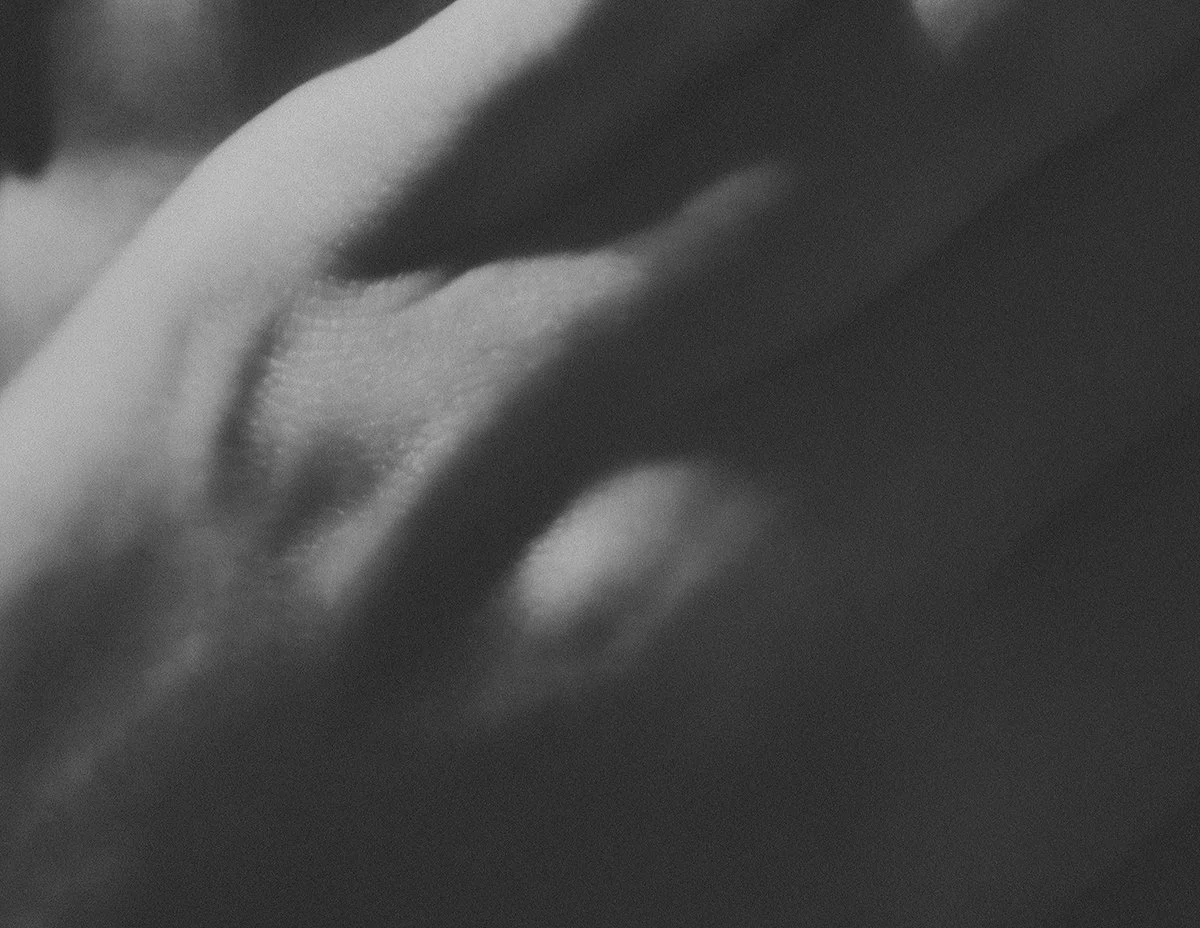
Matilde’s hand; ph: Francesco Coppola
Across more than 90 years of life span, Imogen Cunningham was a child of her time and space: the north western coast of USA, from the late XIX century to the late 70s of the last one, she engaged with the medium with maximum earnestness, passion, and rigor.
Since her first examples of artistic nude photography, when she cited the ancient Greek mythology, or cited with a work like “the wood beyond the world” even the William Morris literature and the long wave of the Pre Raphaelite inspirations, to the later clean and detailed dancers images, she interpreted the human body – male or female – not as an object of desire, but as what it truly is in the real world: present, muscular, powerful or old and decadent.
For her, the development of photographic instruments over time meant the progressive achievement of observing the world as it is, without any superimposed structure of ideals or morality.
There was scarcely any type of camera she didn't master, from the large format ones, to the smaller and faster slrs, she was also a great darkroom operator and printer.
With her poetic eye, she surely is the grandmother of Photography, and for the Artistic Nude too, even though YouTube documentaries lack details about our type of imagery, a grave sign of regress in our sad times.
Shine on!