
Foreword
After having written about Kertész last time, I had originally an idea to treat another photographer born in Hungary, Brassai but, having seen videos and read articles about his type of Photography and approach to nude figure, so inscribed in his street photography activity I decided to pivot instead to a very complicated artistic life and career of Erwin Blumenfeld
Biography
The Man Who Shot Beautiful Women | Erwin Blumenfeld, from Standart youtube channel
Born into a secular Jewish family in Berlin on January 26, 1897, Erwin Blumenfeld came of age in a city whose artistic ferment would shape his visual sensibility even as its political convulsions would eventually force him into exile. His early years gave no obvious indication of his photographic future — he worked in the clothing trade and nurtured literary ambitions, writing poetry while the First World War raged around him.
The year 1918 marked his departure for Amsterdam, a move that proved formative for his artistic development. There he encountered Paul Citroen and Georg Grosz, Dada artists whose provocative approach to image-making resonated with his own emerging sensibility. In 1921, he married Lena Citroen, Paul's cousin, with whom he would have three children. The marriage anchored him in Amsterdam for over a decade, during which he attempted to establish himself as a leather goods merchant — a venture that collapsed in 1935, coincidentally or perhaps fatefully pushing him toward the medium that would define his legacy.
By 1936, at nearly forty years old, Blumenfeld arrived in Paris not as an established photographer but as a refugee from commercial failure, carrying with him only his experimental vision and a growing facility with the camera. The Paris years, though brief, proved explosive. He immersed himself immediately in darkroom experimentation, treating the laboratory as his true studio. Veils, mirrors, wet silk, solarization, reticulation, multiple exposures — these became his vocabulary for exploring what he called his two obsessions: death and women, or perhaps more precisely, the mysterious intersection between mortality and feminine beauty.
Recognition came through an unexpected channel. In 1938, Cecil Beaton, already a celebrated photographer himself, encountered Blumenfeld's work and immediately introduced him to Michel de Brunhoff, editor of Paris Vogue. Until that moment, Blumenfeld had not been a fashion photographer at all. The commission that followed — particularly his May 1939 photographs of model Lisa Fonssagrives posed vertiginously on the Eiffel Tower's iron lattice — announced the arrival of a major talent capable of infusing commercial work with genuine artistic vision.
But when War erupted it just snuffed out his career as fast as previously ignited. As a German Jew in France, he was classified as an "undesirable alien" and cycled through multiple internment camps between 1939 and 1941. These years left little photographic record but deep psychological scars. When he finally escaped to New York in August 1941 with his family, he was forty-four years old and starting over for the third time.
America offered him what Europe could not: commercial success and relative safety. He joined Harper's Bazaar immediately upon arrival, then established his own studio near Central Park in 1943. By 1944 he had moved to Vogue, where he would create some of the most iconic fashion magazine covers of the postwar era. He became highly paid, highly successful, and deeply conflicted about it. He had to struggle with art directors who prioritized commercial considerations over artistic innovation, yet simultaneously taking pride in what he called "smuggling art" into his fashion photographs. This tension defined his American years.
He died in Rome on July 4, 1969, at seventy-two. The decades that followed saw his work gradually claimed by the art world that had largely ignored him during his lifetime, when he was dismissed as merely a fashion photographer. Retrospectives at the Centre Pompidou, the Barbican, and the Jeu de Paume established his reputation as both a technical innovator and a significant artist whose nude work, in particular, deserves recognition alongside his better-known commercial output.
Approach and Style
Beauty in Motion: The Films of Erwin Blumenfeld, from NOWNESS youtube channel
His nude work from the Parisian period reveals a photographer simultaneously looking backward to classical sculpture and forward to surrealist experimentation. The "Nude Under Wet Silk" series featuring Margarethe von Sievers demonstrates his method: the female form becomes simultaneously revealed and concealed, sharply defined yet dreamlike, present yet inaccessible. He once declared that "the greatest magic of the 20th century is the darkroom," and these images prove his devotion to that transformative space where light and chemistry conspired to produce something beyond mere documentation.
Later in USA publicly, he produced elegant, innovative fashion work that pioneered new uses of color photography and secured his commercial reputation. Privately, he continued his personal explorations of form, color, and movement, always returning to the female body as his primary subject. Model Natalia Pascov became a frequent collaborator in these private experiments during the early 1940s — images created not for publication but for the pure pleasure of photographic investigation.
His visual references revealed a man in constant dialogue with art history. He recreated Vermeer's "Girl with a Pearl Earring," quoted Seurat's "Model," nodded to Botticelli's "Birth of Venus," and drew inspiration from Egyptian sculpture of the Amarna period.
"I thought that I was a modern artist, but I turned out to be classical," he reflected late in life, acknowledging how his experimental techniques ultimately served deeply traditional concerns with beauty, form, and the timeless representation of the feminine.
Blumenfeld never resolved the contradiction between commercial necessity and artistic aspiration. In a darkly ironic comment, he once remarked that he owed his career to Hitler — that without the Führer's persecution, he would never have had the courage to become a photographer at all. The statement reveals both his mordant humor and his awareness that displacement and desperation had paradoxically liberated him to pursue his true vocation.
His legacy remains complex: a refugee who became a commercial success, a surrealist who admired classical sculpture, a darkroom magician who spent decades creating images for magazines that allowed him little artistic freedom. Yet throughout all these contradictions, one constant remained — his conviction that the camera and the darkroom together could transform the female form into something simultaneously immediate and mythic, erotic and aesthetic, modern and eternal.
Personal conclusions
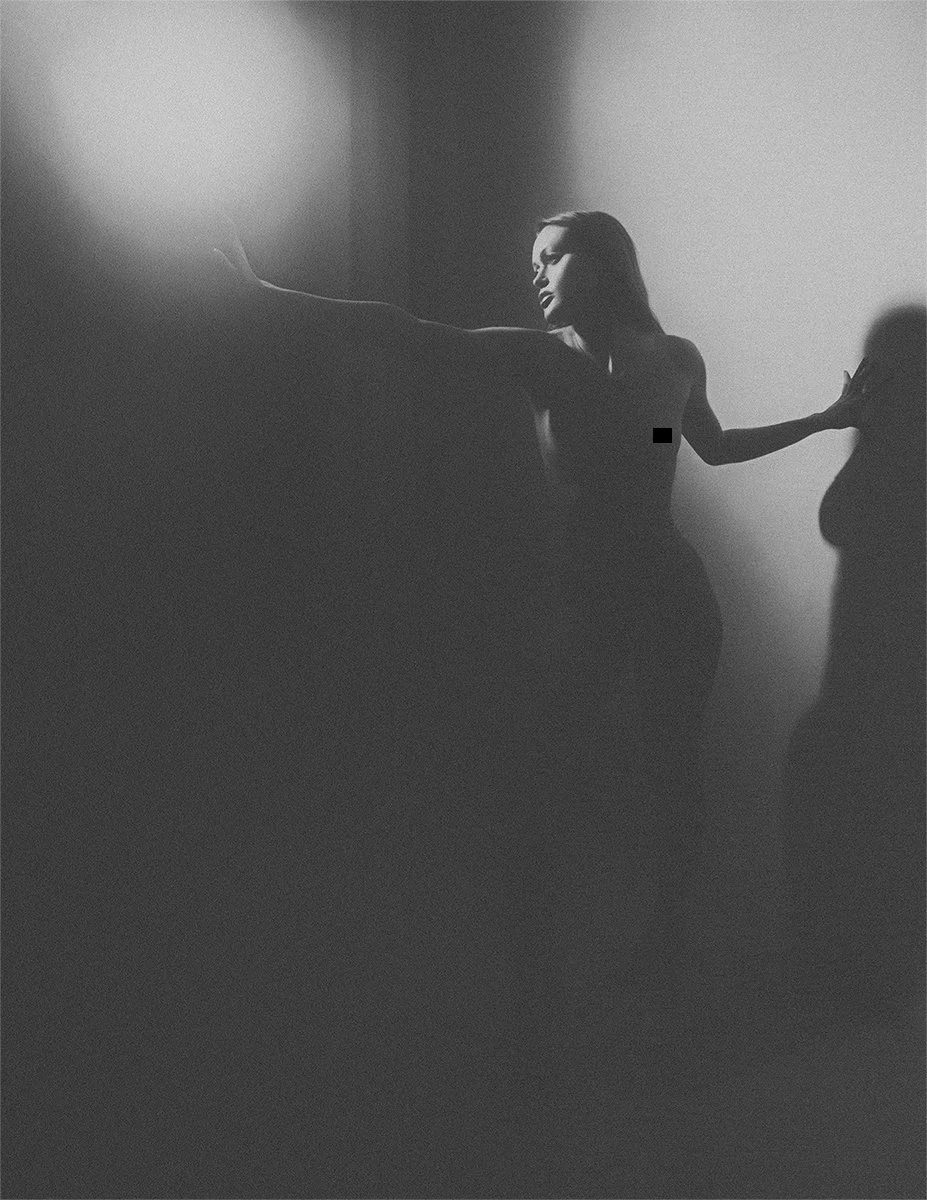
Matilde and the Light; ph: Francesco Coppola
I really feel the struggle between the Photography that pays, commercial and pretending to impose its own little rules, and the free, experimental, artistic spirit of Blumenfeld, the pain of not being recognized as a Fine Art Photographer, with all his dadaist and surrealist influence in his images, above all in the artistic nude images he made.
This said, every season of Mother Earth brings to its more imaginative children its fair share of constrictions and desperations. Today the panorama of Photography and how one, from an unschooled, hobbyist, practice can arrive at the professional level and live with his/her own passion for the Medium has severely shifted.
It is like the shifted perception of the comedy movies with the protagonist called Fantozzi – the hapless office worker from Italian comedy films –, that now in my adult life seems not that bad: he had a job with no contract end, a wife who lived with him through his difficult times, a daughter, a house and a little car. His struggle seems almost enviable now.
With the democratizing of Photography via smartphones, the large general consumption of images on little screens and the incoming new menace of AI generated images, it would be really nice having a more commercial work to fund our artistic practice, but it is getting progressively unachievable, what we are left now, is the artistic, experimental, passionate constant practice with which we can aspire entering galleries and art fairs.
That is all for now. Shine on!
Per aspera ad astra