
Caught in a dark dream – Elio Luxardo
Disclaimer
Elio Luxardo il fotografo dei divi. from MsFrancesco1945 youtube channel (audio in Italian)
Delving into the history of Italian artistic nude photography it is impossible to ignore one author that lived in the 20 years of the darkest period of Italian history, the Fascism era.
It is important here be aware that a dictatorship does not spark and tempestuously gather consensus and finally conquer strict control of a country and its destinies without a cultural movement and one too that has been fully mythological – selling the dream to revive the old Roman Empire.
It was a cultural climate void of practical, concrete, knowledge of human nature and instead all intent on glorifying Youth and the Beautiful Death for the Land of the Fathers or the enthusiasm for speed, combustion engines and airplanes escapades that was the core of Futurism movement. This was the dark dream that immersed Italy in a nightmare that only the harsh bite of reality brought by the War fought along pretty all the peninsula could break.
For a 24 years immigrant Brazilian like Elio, arriving in Rome in 1932, with his attention to shapes, lighting and classical culture, being captured by the fascination of fascism propaganda was all too easy.
Soon he would be involved in the Cinema scene of the “Telefoni Bianchi” movies era, the Italian aristocracy and the artistic scene — there he found occasions to practice and muster his skills, giving full vent to his inspirations.
During the war years he made choices that went well beyond political naivety — serving as photographer to the notorious Decima Flottiglia MAS, a corps that alongside acts of genuine military courage was also responsible for brutal reprisals and the massacre of partisans in Liguria. To document that, to lend one's artistic eye to that cause, carries a moral weight that cannot be quietly set aside.
Yet for those of us living in 2026, the full complexity of history demands to be seen whole — not to absolve, but to understand. It is in that spirit — clear-eyed about the darkness, and attentive to the art that somehow coexisted with it — that we offer here the biography, photographic approach and personal considerations about Elio Luxardo.
Biography
Elio Luxardo e il cinema - mostra digitale from Fondazione 3M youtube channel
Elio Luxardo was born on August 1st, 1908, in Sorocaba, Brazil, to Italian emigrant parents. His father Alfredo, originally from Pisa, had left Italy in 1900 to run a small photographic studio, and it was there, working alongside his siblings, that Elio first learned the craft. An accomplished swimmer and athlete in his youth, he also produced sports documentaries commissioned by the Brazilian government before the family returned to Italy — around 1932 according to most sources.
In Rome he briefly enrolled at the Centro Sperimentale di Cinematografia, dreaming of becoming a director, but soon abandoned formal study to work under royal photographer Sem Bosch, whose studio he would take over within months. He set up at Via del Tritone 197, where his innovative use of cinematic lighting — learned from studying American films — quickly earned him a reputation among the stars of Cinecittà and the Italian aristocracy, sharing that refined clientele with fellow portraitist Ghitta Carell. His family worked alongside him: brother Aldo and sisters Elda and Aurora handled developing and retouching. It was also a family touched by remarkable connections — his sister Elda would later marry film producer Salvatore Argento, making Elio the uncle of director Dario Argento.
In 1942 he met Gertrud Kraus, a German citizen serving as interpreter to Field Marshal Kesselring's headquarters in Rome. They married just days before the Armistice of September 8th, 1943, and fled Rome together on the day Allied forces entered the city, joining the Decima Flottiglia MAS on June 4th, 1944, where Luxardo held the rank of lieutenant and headed the photographic division.
After the war he rebuilt, opening a new studio on Corso Vittorio Emanuele in Milan — funded partly by money his siblings had earned working with the Allied forces in liberated Rome. His postwar clients ranged from La Scala opera singers in Milano to Miss Italia candidates. He became a regular contributor to Ferrania, Italy's first photography magazine, and won its prestigious Motta-Ferrania competition three times in the professional category. He also created the iconic donnina Ferrania, a pin-up style display figure that became one of the most recognizable advertising images of the era. A close friendship with Federico Fellini marked his later years.
Luxardo eventually withdrew to Sperlonga, perhaps searching for some echo of the Brazil of his youth. He died in Milan on November 27th, 1969. His debts forced his wife to close the studio and cede the entire archive to Fondazione 3M — a collection now numbering some 110,000 images.
His Photography
Exhibition trailer “Elio Luxardo - Corpi Nudi” from ArtHera TV - Multimedia Art Projects youtube channel (audio in Italian)
Luxardo's defining characteristic as a photographer was his cinematic approach to light. Having grown up on film sets and studied the work of great Hollywood studio photographers — Robert Coburn, Clarence Sinclair Bull, László Willinger among them — he treated his studio as a director treats a set, sculpting his subjects with shadow and highlight rather than simply recording them.
His portraits were never repetitive because they never followed a predetermined aesthetic formula. Instead, they arose from instinct and acute observation — a particular glance, an unusual posture, a quality of expression that he would isolate and amplify. Whether photographing politicians, nobility, writers or ordinary people, he gave each subject the presence of a film protagonist.
His personal artistic research, however — the work he made for himself rather than for clients — is where his deepest originality emerges. His nude studies, predominantly from the early 1930s and never intended for commercial circulation, draw from his early passion for sculpture and his admiration for Greek and Roman classicism. The female nude in these images has an ethereal, light-sculpted quality far removed from the rhetoric of the era's domestic femininity. The male nude carries a muscular, heroic energy that anticipates, in some critics' view, the later work of Robert Mapplethorpe. The two exist in a productive tension — the virile and the evasively erotic in quiet confrontation.
His broader artistic references were eclectic and knowing: the Futurist movement and Margherita Sarfatti's Novecento in his early years, the sensual vitalism of Edward Weston in his nude work of the mid-thirties, and in fashion the elegance of Cecil Beaton, Hoyningen-Huene and Horst P. Horst. He published regularly in Bellezza, Cine Illustrazione, Vogue and Harper's Bazaar.
Paradoxically, his nude photographs — too pin-up for the Fascist era, too stylistically rooted in that same era for postwar taste — disappeared for decades, lost in the sediment of history. Their recent resurfacing, most notably in the 2025 exhibition Luxardo. Corpi Nudi at the Fondazione Nicola del Roscio in Rome, has allowed a proper reassessment of a body of work that was always too alive to stay buried.
Personal conclusions
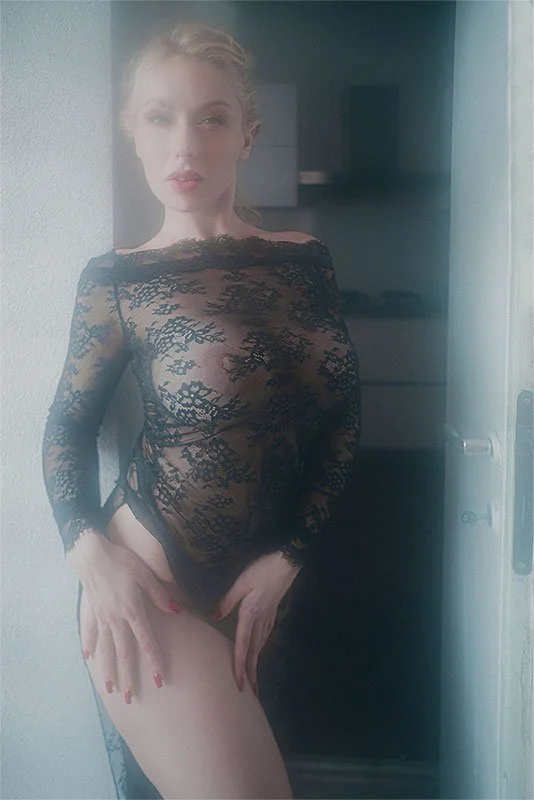
Lorenza Caradonna at the door; ph: Francesco Coppola
An athlete born far from his parent’s native nation, arrived in Italy in a vivid but heavily controlled culture scene that welcomed him and he loved to be treated that way. His nude studies were not accepted by that regime circle, though and in there we can witness something different from what usually could be represented in the fascist era, above all for the feminine figure.
Yes, his male subjects are surely virile, muscular, heroes of their scene, but women weren’t the passive hearth angels. They were seductive, elusive heroines of their own scene too. Maybe was that the problem with Luxardo’s nudes that the regime couldn’t accept after all?
They could be shy nymphs, capable to steal glares and hearts, but equally to disappear in the deep of a deep wood in which a stream of water flows on crisp splashes through, more than young candidates to be mothers to carry new meat for the cannon fodder.
In that aspect – personally – I can see a way, usable even today, to talk about the nature of genders and of their interactions. After all, what has been really all the ancient Greek mythology production if not a great psychological session? Or so I perceive it since I gladly read the brilliant guide on how separate the syncretic mixture of Latin way to look at gods and myths from the Greek one titles, “the wedding of Cadmus and Harmony” by the late author Roberto Calasso.
Isolated in the fascist cultural isolation, he lived in the same time of authors like Man Ray and Edward Weston in those years when he produced that type of artistic nude material, a disadvantage maybe (surely a contact with the psychology enthusiasts like surrealist could have strengthened his moral compass) but also gave him a stylistic freedom that in later years connected to international authors, like Mapplethorpe, Weston himself.
In the end, Luxardo is in our history and cultural heritage no matter what and his example is precious to have a more complex vision on human beings, that can reach absolute heights, and dreadful pitfalls.
As it is my personally forged firm-like motto on Facebook: “Complexity is inescapable and the only constant in the world is change”.
See how useful can be Art, History, Psychology and Philosophy?
Save yourself from simplistic answers! Shine on!
Per aspera ad astra