
Twilight of the Artistic Nude Photography genre: Robert Mapplethorpe - Perfection on the Edge of Darkness
Biography
Mapplethorpe: Look at the Pictures (Documentary, 2016) from Fanny 1985 youtube channel, original documentary by HBO
Born on November 4, 1946, in Floral Park, Queens, New York, he grew up in a strict Catholic household — a religious formation that would leave permanent traces in his aesthetic grammar: the symmetry, the devotion to formal purity, the sense that beauty and transgression are inseparable.
From collage to camera
Mapplethorpe enrolled at the Pratt Institute in Brooklyn in 1963, studying drawing, painting, and sculpture — a fine arts foundation that would define his photographic sensibility for life. He worked for years in mixed media collage, and only in 1970, when he acquired a Polaroid camera for source material, did photography take hold of him. His first solo exhibition, at the Light Gallery in New York in 1973, was titled simply Polaroids.
Two relationships proved decisive. The first was with Patti Smith, poet and musician, with whom he had lived since 1967 at the Chelsea Hotel. Smith was his first sustained model — he photographed her most iconically for her 1975 debut album Horses, one of the defining portraits of the era. The second was with art curator Sam Wagstaff, met in 1972, who became mentor, patron and companion, and who gave Mapplethorpe the Hasselblad camera with which he would build his mature body of work.
Sculpture in two dimensions
Amazing Lessons In The Photos Of Robert Mapplethorpe from The Photographic Eye YouTube channel
Mapplethorpe once said that "photography is a great way to make a sculpture," and this unlocks everything about how he worked. He was not interested in spontaneity or the decisive moment. He worked almost exclusively in the studio, with controlled lighting and an obsessive pursuit of what he called "perfection in form." Subjects faced the camera in perfect bilateral symmetry, backgrounds neutral, light sculpting rather than illuminating. The result was an aesthetic of severe, cold beauty.
His photographs of the male body were deliberately positioned within the tradition of classical sculpture — bodies fragmented into torsos, arms, thighs, the formal vocabulary of the museum applied to living flesh. In 2009 his photographs hung alongside Michelangelo's David at the Galleria dell'Accademia in Florence. The same rigor governed his celebrity portraits and his flower still lifes equally. As he put it: "I don't think there's that much difference between a photograph of a fist up someone's ass and a photograph of carnations in a bowl."
Controversy and the culture wars
By the late 1970s, Mapplethorpe was documenting New York's BDSM scene with the same formal discipline he brought to his lilies. Diagnosed with AIDS in 1986, he accelerated rather than slowed — receiving his first major retrospective at the Whitney in 1988 and founding the Robert Mapplethorpe Foundation that same year to promote photography and fund HIV/AIDS research.
He died on March 9, 1989, aged forty-two. His posthumous exhibition The Perfect Moment ignited a national firestorm: the Corcoran Gallery cancelled its hosting, Congress debated public arts funding, and the Cincinnati Contemporary Arts Center was actually tried for obscenity — and acquitted. Mapplethorpe became a symbol for both sides of the culture wars: proof that art must go where morality fears to tread, or proof that the line between art and pornography had been deliberately dissolved. Both readings contain something true.
Personal conclusions
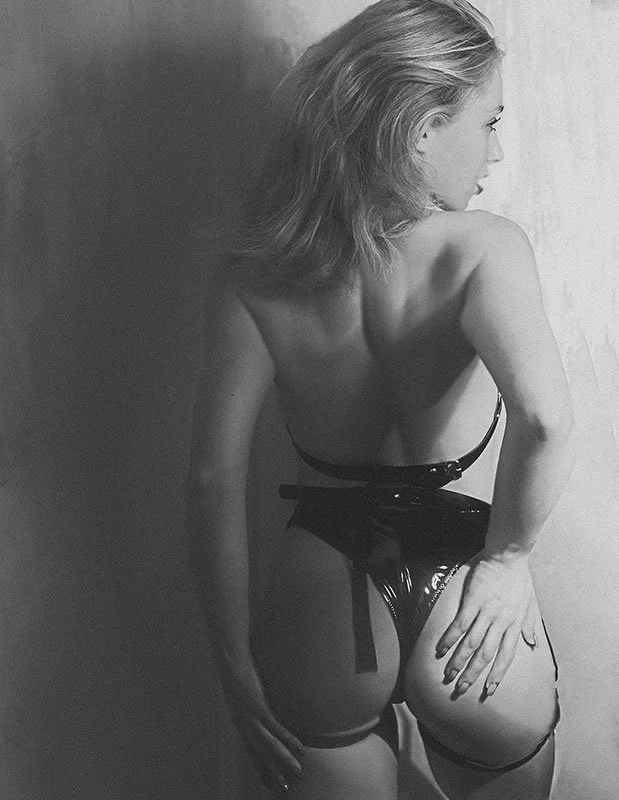
Lorih Caradonna in an exercise with fetish outfit from june 2025; ph: Francesco Coppola
There are artists who photograph the world as they find it, and there are artists who photograph the world as they demand it to be. Robert Mapplethorpe belonged unambiguously to the second category.
As an Italian photographer I understand his upbringing and approach — even if it is not my own. I stand in the first field mentioned above: photographing the world as I find it, only that I am more interested in the usually invisible psychological inner world.
I am an historian by university formation, so I understand the context in which he developed his skills — the roaring 80s in the midst of New York's cultural and artistic scene portrayed by Aerosmith song “Heart’s done time”. Nonetheless, I have always been disturbed by borders that are too rigid, too precise, bleeding-edge. Sculpture is one thing; the human body – and mind – are entirely another.
I am also sovereignly uninterested in bondage visual culture, and I will keep repeating that the 2020s are no longer an age of transgression — not so much for any notion of conventional morality, but because the diffused normality of stable relationships that defined the 80s no longer exists in the same way. Even LGBTQ2+ relationships have fled the wardrobes from quite some time now and are, on the contrary, desperate to find that same stability we straight people don’t find anymore.
All this said, Mapplethorpe's artistic intent is undeniable. I do not approve the cancellations his memory suffered shortly after his death — even understanding that the late 80s and early 90s were an era of schizophrenic cultural fear of AIDS, before something like the film Philadelphia closed that particular chapter of madness. It was certainly a good thing that he established his Foundation before dying.
Yet the damage was done. Bad actors in image culture after him — spreading ever more widely with the growth of the internet — pornographic and commercial imagery of undressed women, together with controversies around photographers who came after, launched what I have called the Twilight era for artistic nude photography.
Something that, I really hope, we can reverse now.
Shine on!