
Twilight of the artistic nude photography genre: David Hamilton and his Lost Paradise
Biography
Hommage à David Hamilton. MERCI à GETTYIMAGES et Francis Lai pour la musique Bilitis.Frédérique Teuma from
Teuma Frederique YouTube channel
David Hamilton was born in London in 1933. he trained as a graphic designer and worked through the 1950s and early 1960s as an art director, most notably in Paris for the influential German magazine Twen under Peter Knapp. It was a rigorous commercial apprenticeship in the grammar of image-making.
The decisive biographical episode, and the one that arguably shaped everything that followed, was his wartime evacuation as a child to Dorset, on the southwest coast of England. Hamilton would spend the rest of his creative life photographing that suspension.
He moved permanently to France — first Paris, then the village of Ramatuelle near Saint-Tropez, on the southern coast — and it was there, in the heat and stillness of the Mediterranean, that his mature work took shape. He exhibited internationally, in Germany, Italy, the United States, and throughout France, and published dozens of photographic books that sold in the millions. He also made five films — among them Bilitis (1977) and Tendres Cousines (1980) — which extended his photographic language into narrative, retaining the same amber light and languid atmosphere.
He died in Paris in November 2016.
Technical Style & Painterly Quality
David Hamilton on Francesco Guglielmino’s YouTube channel
Hamilton's signature technique — the one that made his images instantly recognizable and placed him in a complex, productive dialogue with painting — was a form of deliberate optical diffusion achieved by shooting through materials interposed between lens and subject: layers of gauze, tulle, or glass, sometimes combined with a light coating of petroleum jelly on a filter. Light itself becomes a substance, a medium through which the subject is perceived rather than simply recorded.
The result is a visual register that has clear antecedents in the history of Western painting — specifically in the French academic tradition of Bouguereau, in the soft-edged reverie of the Symbolists, and in certain Pictorialist photographers of the early twentieth century who similarly sought to dissolve photography's mechanical sharpness into something warmer and more subjective.
His color palette reinforces the historical and emotional argument. Consistently the dominant tones are warm: dusty ambers, bleached whites, the particular gold of afternoon Mediterranean light in late summer. Light diffuses used to embrace the settings and the subjects. It wraps — across thousands of images made over four decades — with a disciplined visual intelligence.
His films carry this quality intact. Even in the necessarily more complex visual grammar of cinema — with movement, sequence, dialogue — the characteristic glow persists. The gauze if anything, it reveals the degree to which the technique was applied as a philosophical position: the world, in Hamilton's vision, is always slightly out of reach, always perceived through something — through memory, through longing, through the irreversible distance between the present moment and the luminous past.
The Eternal Summer — Thematic Analysis
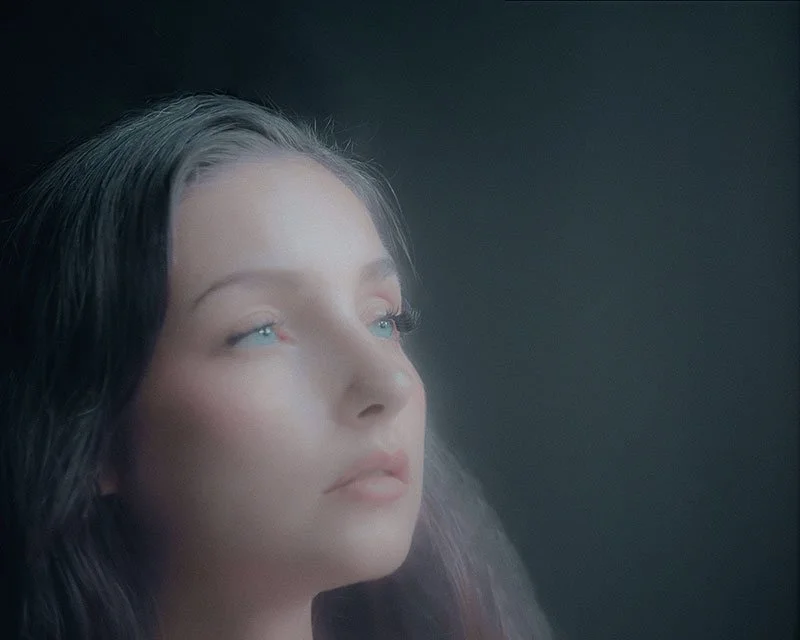
Fabiola Pietrasanta in my october 2025 shooting; ph: Francesco Coppola
To ask who the young women in Hamilton's photographs are is to misread the work — or rather, to ask the wrong question first. The true subject of Hamilton's work is a condition: the threshold between childhood and adulthood, perceived from a particular angle: one of suspended time, of serenity untroubled by consequence, of a body discovering itself in a landscape that seems to exist outside of history. The girls are always between. Between sleep and waking, between water and shore, between one season of life and the next. They are never arriving at anything. That is the point. Arrival would break the spell. Someone in our contemporary times could define this a quantic beauty work, if that is so, it could testify the long-time validity of his imagery.
Hamilton’s paradise is not simply a beautiful place; it is a place from which one is eventually expelled. Not simply Eden but Eden in retrospect. The Dorset countryside of Hamilton's wartime childhood was not paradise at the time — it was exile, in a general nationwide disruption, the world turned upside down. It became paradise only in the imagination, once it was gone, reconstructed by memory into something it may never quite have been. Hamilton spent his career building that reconstruction in images — warm, soft, out of reach.
In this sense his work belongs to a deep tradition in Western art and literature: the pastoral, the Arcadian fantasy, the idealization of youth and countryside as an antidote to the pressures and corruptions of adult life. What distinguishes Hamilton is the photographic medium itself, and what he demanded of it. His truth was interior. It was the truth of what the imagination does to experience once experience has become the past.
Personal considerations
Arriving here we cannot miss to mention the late accusations that afflicted his later years. After all, why insert this author in the “twilight of artistic nude” photography if he did such a brilliant work?
Because going his life surpassing the 80 years, he has been accused to have been a pedophile who raped the young models that parents brought him to shoot with. First to open this line of fire upon him was one of his ex-models Flavie Flament one that waited to arrive at the age of 38 before accusing Hamilton to have assaulted her when she was only 13. After her more ex models of him made other similar accusations and he died, allegedly by committing suicide, before any trial could have been held.
Thus, the truth about these accusations is not assessed. But I am writing these words in 2026, 10 years after the event, but also after all the “Me too” movement that touched many, once powerful men, once so popular and acclaimed, gate keepers for the success of many young models and actresses. So, we can postulate that the accusators are in their own right sincere, that the long time it took them to express their wounded testimony were caused by the cultural climate that dominated the years between the 80s and early 2000s that they waited for so long.
This said, is valid my insertion of putting this photographer into this branch of my artistic nude photography history, make us understand and be aware of the difficulties in practicing and promoting such a delicate kind of art photography making and surely, I don’t want absolve Hamilton, and this is beside the point of this entire article.
What is my point is that the sentence made in 2016 by that New York times journalist that because of those accusations his work, his style, fell out of fashion. Bullshit! Soft porn? Go visit the rich catalogs of a Edward Weston and other American (and not) authors of artistic nude photography and tell me if there is a different approach of depicting the naked body.
Hamilton’s ambition was explicitly painterly: to make photographs that could stand, without apology, in a fine art gallery alongside paintings and drawings. In this he largely succeeded. In that Hamilton has been successful and his is a genuine contribute to continuing the noble tradition of Fine Art Photography that is visible in art museums! His books were treated as art objects. His exhibitions drew serious critical attention.
Another point to make here is that while the ignorant eye catches the obviousness of the youth of the models used in his shootings, they lack to perceive the real subjects of all his imagery: a gateway, time restricted, suspended time of coming of age of a particular time period too. His youth was different from ours. We are easily more troubled and our Young are, deprived as they are of the friendliness of the concept of “Future”. Future nowadays is so scaring that many try to not look at it, surely not live under its shadow.
But his youth was peaceful, eternally in the natural warmth of summertime, the watches there could easily melt away. It is a countryside idealized territory, an arcadia, protected from the bombings and the horrors of war, but also by modernity’s squalor. The observer is aware that his place is not the one he is witnessing and that sooner or later he will return to a colder reality were the lancets of the watches bring choices, consequences and bleeding edges.
Something like our own times, don’t you think?
One can argue, also, that in his internal world there are only young, beautiful, teen girls. No males, no one in bad shape, no one bringing on them the signs of famine or war. I don’t dispute this and if you really want in his “coming of age” sexuality is very apparent - of all the aspects that anyone navigate in his normal upbringing - but here I bring you one of our photographers of the past Lucien Clergue and his reaction to his country fell in war time, he too had to resort to Beauty and a nude too.
Here with Hamilton, we lack the depiction of crude death that Clerge instead included in his work, but - look - we are not that afar.
That type of research of imagery is only a geological pressure of one artist’s spirit that brought him this diamond like inspiration. Something brilliant to lay on the wounds of an experience we can only imagine.
Shine on!