
Twilight of artnude photography genre: Bill Henson — A Vision from the Shadows
Biography
Bill Henson: Dreams of Darkness (documentary excerpts) by
Stella Motion Pictures youtube channel
Born in Melbourne in 1955, Bill Henson demonstrated an exceptional artistic sensibility from a very young age. He briefly attended the Prahran College of Advanced Education between 1974 and 1975, studying Visual Arts and Design under photographer Athol Shmith, without completing his diploma. Nonetheless, Shmith recognized his talent and promoted his work to Jennie Boddington, inaugural Curator of Photography at the National Gallery of Victoria, with the remarkable result that Henson held his first solo exhibition there in 1975, at just nineteen years old.
In the years following, Henson travelled and photographed extensively in Eastern Europe, and taught briefly at the Victorian College of the Arts in Melbourne. His work progressively gained international recognition, with exhibitions at the Bibliothèque Nationale in Paris, the Venice Biennale — where he represented Australia in 1995 — the Solomon R. Guggenheim Museum in New York, and many other major institutions worldwide. His photographs are held in virtually every significant public collection in Australia, as well as internationally in institutions such as the Tate Collection in London, LACMA, the Museum of Fine Arts in Houston, and the Museo Nacional Centro de Arte Reina Sofía in Madrid. In 2024 he was appointed an Officer of the Order of Australia for his distinguished service to the visual arts.
In 2008, the opening night of his exhibition at the Roslyn Oxley9 Gallery in Paddington, Sydney, was cancelled following complaints to police regarding photographs of a nude thirteen-year-old girl included in the show. Images were seized and a national debate ensued, reaching the highest levels of public life. The New South Wales Department of Public Prosecutions ultimately recommended no charges be laid, and the Australian Classification Board rated the contested images as mild.
He continues to produce new, heavily atmospheric work that is exhibited commercially, despite enduring attention regarding his 2008 controversy.
His Photography and Technique
Artist Bill Henson remains defiant in defence of his work by ABC youtube channel
Henson's visual language is immediately recognizable and deeply distinctive. At its core lies a masterful use of chiaroscuro — the dramatic interplay of light and shadow associated with painters such as Caravaggio and the Dutch Golden Age masters — achieved through deliberate underexposure of negatives and precise control of artificial lighting. The resulting images are not so much photographs as they are painted visions: dark, brooding, and suffused with a quality of light that feels simultaneously ancient and immediate.
A key technical signature is his printing process, which intentionally drains the images of most of their color, retaining only faint traces. Combined with the underexposure, this produces an otherworldly, dreamlike atmosphere that pushes the work far from any documentary or descriptive function. It is worth noting how this approach differs fundamentally from other photographers who pursue a similar dreamlike aesthetic — David Hamilton's soft focus, for instance, was achieved through shooting through gauze or similar materials, preserving color and warmth. Henson's path to the dream runs instead through shadow and near-absence of color, arriving at a colder, more enigmatic destination.
He further employs bokeh blurring and flattened perspectives through telephoto lenses, and frequently presents his work as diptychs or triptychs, curated with what he himself describes as a sense of musicality — images grouped and sequenced rhythmically, so that the overall exhibition functions almost as a composed piece rather than a collection of individual works. Faces in his photographs are often partially shadowed or turned away from the viewer, denying easy identification and pushing the subjects toward the archetypal rather than the personal.
His subject matter ranges from adolescent portraits to emotive landscapes and staged theatrical tableaux, all united by recurring themes of duality, the sublime, and the transitional — particularly the threshold between childhood and adulthood, between the known and the unknown. Henson has stated explicitly that he pursues no political or sociological agenda; his interest is purely in the sensory and emotional experience the image can provoke.
Personal considerations
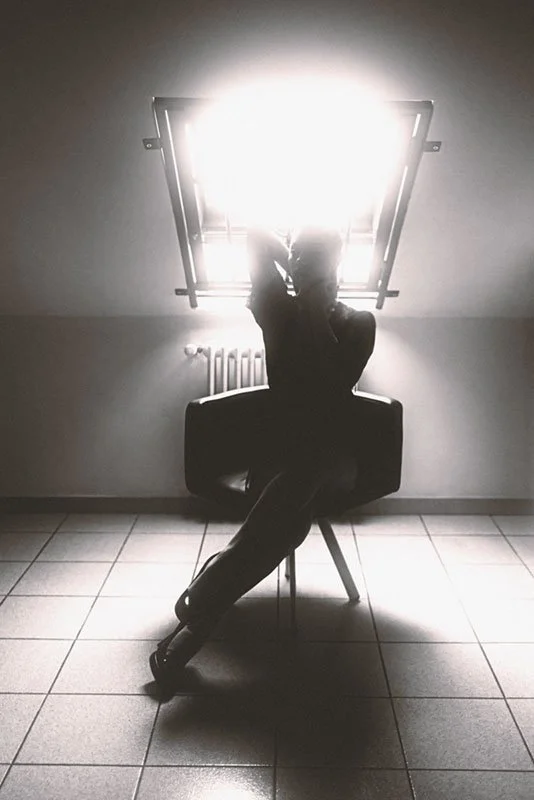
Deborah backlit; ph: Francesco Coppola
Let us reconstruct what happened to Henson in the controversy he ran into, with that accident in 2008 with that gallery in Paddington. A group of people invited by the gallery to visit a private part of the exposition were scandalized by seeing there were images of a naked thirteen-year-old girl. The invite himself tells us that that artwork was not open to the general public and that most probably, security aside, the gallery owner made simply a commercial move, as usually they do, or it looks like a lot to me. After that much of the people who expressed their disdain for those images seem to have done so not by watching the material, but only having heard or read about it – a usually dire situation in which one can find himself immersed in.
Surely, the fact that the police arrived and seized the images in question to evaluate their complying or diverging for the local law about child protection worsened a discussion where only those initial accusers had seen the material. As often happens, the fact that the artist was not found guilty of anything and those images have a mild erotic characteristic passed pretty under silence.
Since then, he has been under the attention of the public opinion eye, but nevertheless he is still working in Melbourne and continuing to express himself through the photographic medium, participating in the general cultural debate as he fully deserves to do.
The whole debate about his art contributed to the difficult situation that the art nude photography is living with now, that is why I inserted Henson in this twilight side of the artistic nude photography genre.
Be mindful, though, all that controversy is not a fault of Henson himself, but of the general cultural climate that surrounds it. We have lived for some time now in a world where the public opinion has witnessed the spreading of pornography and the diffusion of web platforms used to earn money with sexual content.
The more instinctual, immediate, response in finding on a gallery wall, or on a computer screen, if not a smartphone screen, a beautiful nude body is thinking that the image has been produced for exploitation of sexual basic desires. It requires education to evaluate the context, the depth, the intent.
More than this, Henson’s research of emotional images, including unclothed young girls and boys, are not a depiction of real interactions in the common perceived world. The first misconception here is that the kind of his artistic photography has not any pretending to represent a reality of any sort, if not the psychological, emotional ones.
His themes are about age passing, solitude, longing, how music can make an elderly man feel young in a Paris opera, for instance. Thus, one should first try to understand what is the intent of the artist, not starting accusations before even watching the images themselves.
The beauty of a female body, even very young, carries a whole range of significances — a concept rich enough that tales upon tales can be told through the collaboration between artist and subject.
Henson is surely an artist to reckon with, his research is an example to follow without losing any more time with the sterile rules to follow as dogma. Considering too the AI advancement and the adoption into Fashion Photography world, the safest way to earn a living with our own passion can be only artistic photography.
Shine on!