
Biography
I. The Convent World
How Joyce Tenneson Photographs Light Like Nobody Else by
The Photographic Eye youtube channel
Tenneson was born in 1945 and grew up on the grounds of a Catholic monastery where her parents worked, an environment that she herself described as something out of Fellini movie: filled with symbolism, beauty, and a disturbing kind of surreal imagery. It was a world apart from ordinary American childhood — enclosed, ceremonial, populated by women in white habits moving through shadowed corridors. That world became the permanent substrate of her imagination. It gave her, before she had a name for it, a visual language: the language of revelation, of the body as vessel, of light as something more than illumination.
II. Formation: From Painting to the Lens
Tenneson's path to photography came from a serious academic formation in the fine arts. She earned her Bachelor of Arts from Regis College in 1967, her Master of Arts from George Washington University in 1969, and eventually a doctorate from Antioch College in 1978. Her original discipline was painting, and it was only during her postgraduate years that she migrated toward the photographic medium, drawn by its immediacy and its unique capacity to capture what she called the inner life of a subject.
III. The Polaroid Encounter and the Dissatisfied Model
The trigger for her photographic vocation arrived through an unlikely door. During her graduate years at Harvard, Polaroid was seeking models to test their new colour films. Tenneson agreed to model. The experience was instructive: when she saw the photographs that male photographers made of her — sweet, conventional, decorative — she was indignant. That was not Joyce Tenneson, she told herself. Joyce Tenneson was a strong woman going places in life.
That indignation became a camera. She began photographing herself — not as decoration, but as inquiry. The early self-portraits were raw explorations of interiority: feelings of uncertainty, loneliness, the difficult inner landscape of a young woman navigating a world largely constructed by and for men.
IV. Fifteen Years in the Classroom, and a Dismissal That Backfired
For fifteen years, Tenneson taught art in Washington D.C. schools. She was, in fact, the first woman in the city to teach photography at college level — a distinction that brought her not recognition but resentment. Her male colleagues dismissed her work as typical women's photography: too personal, too emotional, too interior.
Tenneson responded by placing an advertisement in photography publications across the country, inviting women photographers to send her their self-portraits. Her postbox was flooded with responses. From this collective act of assertion, she compiled In/Sights: Self-Portraits of Women, published in 1978 — the first anthology of self-portraits by women ever published. The book sold out immediately and was named one of the five most important photography books of that year. What had been intended as an insult had launched a career.
V. New York at Thirty-Nine: The Leap and the Giant Polaroid
In the early 1980s, at the age of thirty-nine — an age at which many artists feel their formation is complete and their trajectory fixed — Tenneson made the most consequential decision of her life. She resigned from teaching and moved to New York to pursue her art full time. She arrived with a stated ambition that was, by the standards of the commercial art world: she wanted to bring a sense of the spiritual into the world of commerce.
Shortly after her arrival, she was awarded a grant by Polaroid to work with one of their rare and extraordinary 20x24 large-format cameras — a machine the size of a wardrobe, producing prints of exceptional luminosity and textural depth. It was the perfect instrument for her purposes.
Working in her New York studio, newly arrived and still finding her footing in an unfamiliar city, she invited women with whom she felt a deep personal kinship into her studio and photographed them as surrogates for her own spiritual and emotional journey. The resulting body of work became Transformations, published in 1993 — and it was, in the language of the art world, a breakthrough: catapulting her into prominence and establishing definitively the visual vocabulary for which she would become known.
VI. Acclaim, Covers, and the Paradox of Invisible Fame
From Transformations onward, Tenneson produced a succession of acclaimed photographic books — among them Illuminations (1997), Light Warriors (2000), and others that extended and deepened her exploration of the female figure (but not only), as spiritual vessel, and the territory where mythology meets private experience. The recognition followed accordingly: American Photo Magazine ranked her among the most influential women in the history of photography. Her images appeared on the covers of Time, Life, Newsweek, Esquire, Entertainment Weekly and the New York Times Magazine, among others.
Nowadays she lives between New York and Maine and works to her new projects while teaching photography in various workshop and courses.
Her photography
Renowned photographer Joyce Tenneson explains the magic behind, "Suzanne and the Swan." from
Immutable Image youtube channel
To understand Joyce Tenneson's photography — its atmosphere of ritual, its obsession with mystery and the feminine, its almost sacred quality of light — one must begin in a convent, during her childhood experiences in the convent fields before than in a darkroom.
This way we can better understand the props used in her images, like the swan or the shark skull, or again a tissue shaped as a flower petal to adorn the model’s head, like symbolic keys to her spiritual narrative that, while keeping at times a sensual feature, distanced her work from the contemporary photographer’s more erotica styles.
Important too are her origin in painting. It explains everything distinctive about her photographic sensibility: the centrality of the subjects in her compositions, the tone and textures imbued with glowing light, thus her images feel more like paintings that have somehow been charged with presence. She came to photography as an artist who had already formed her vision — the camera was simply a new and more intimate instrument for it.
The large-format camera that Polaroid granted her is the largest Large Format used and very rare too. Its extraordinary rendition of skin, fabric and tone is inseparable from the distinctive luminosity of her work in Transformations and beyond.
It is important to understand, though, that most of her career happened during the late film era and she was too a master and experimenter in the darkroom. In the darkroom she taught herself, experimenting with complicated, previously unseen techniques that are another motivation why her imagery has that extraordinary qualities.
Personal conclusions
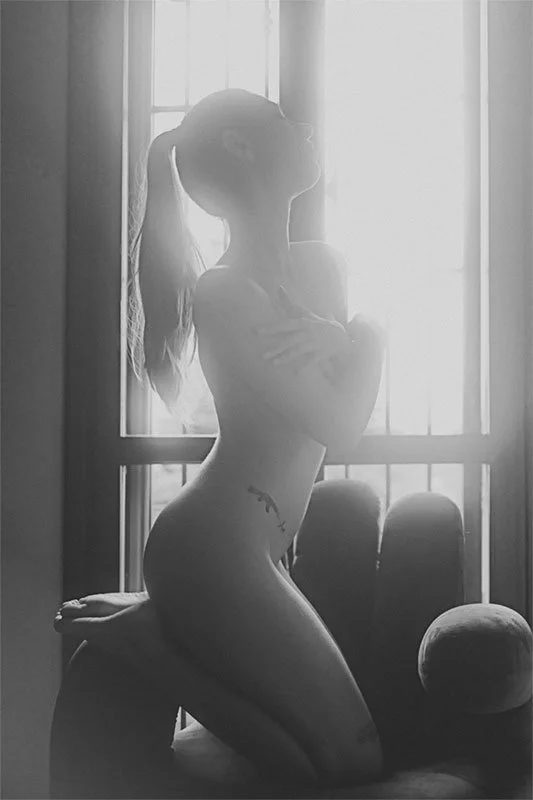
Present absence; ph: Francesco Coppola
There is a paradox that defines her position in the culture — Joyce Tenneson never became a household name. Her images are among the most widely seen photographs of the past four decades. Her influence on a generation of women photographers is profound and traceable. But outside the world of photography and the art market, she remains largely unknown to the general public.
She exists in that strange territory where true artistic influence operates: shaping the visual culture invisibly, recognized by those who make images but absent from the conversations of those who merely consume them.
Tenneson herself has never seemed troubled by this. When asked about her awards and recognition, she deflects. She does not think of herself as successful, she has said. To her, she is still on the journey — still mining that inner territory, still holding the camera up as witness to something that resists easy naming.
That is perhaps the most coherent thing one can say about her: she has never stopped being the woman who looked at those early Polaroid portraits and felt, with certainty, that they had missed the point entirely.
And yet, this said, here we have a bright alternative to Helmuts Newton’s influence, one did not get old but it is ever enduring in art galleries and through the photo artists.
Her material paste of her imagery, lit by her personal and authorial liquid light makes photographers even today — so lost in the poor digital world — wonder how she obtained such stunning results. Refreshed too in seeing the beauty of feminine bodies not represented simply as food for male’s hunger only, but as an epiphany of nature’s essence. Images that talk about relationships, change, challenging times and renovation with every season passing. So much more than only sexual drive and lions in the cage fetishes.
I can say this: if you practice this photographic media, self-taught or after any type of studies, go see if you can find exhibitions of her or one of her books and delve in it, practicing and experimenting, you will start learning how to read images, seeing their real value and possibly elevating your own image making.
This would be a safer and more future proof trail to path in then idiotically continuing rehearsing the same old mantra of perfect IQ imaging, believing in the false narrative that the camera brands and the photo enthusiast continue vomiting.
Shine on!
Per aspera ad astra