
Augusto De Luca — The Body as Form
Biography
Masters of photography | Italia | Augusto De Luca on MrClana youtube channel
Augusto De Luca was born in Naples on July 1, 1955. He frequented a classical high school and went on to graduate in law. Photography entered his life in the mid-1970s, and the pull was strong enough to redirect his career entirely becoming a professional photographer.
Naples shaped him. He has described the city as a place that demands an oneiric interpretation — dreamlike by its very nature, impossible to read as a simple document of reality. That quality runs through everything he has made. His photographs carry the weight of a place that has always lived between the visible and the imagined.
His first solo exhibition was held at the Centro Teatro Spazio Libero in Naples. From there his reputation grew steadily. He taught photography at the Montecitorio Club of the Italian Chamber of Deputies, placing him at the center of the country's cultural and institutional life. In 1987 he directed the set design for the television program Samarcanda, produced by journalist Michele Santoro.
The institutional recognition came in 1995, when an exhibition of his photographs at the Italian Chamber of Deputies was attended by Carlo Azeglio Ciampi, Nilde Iotti, and Giorgio Napolitano — two of the guests would later serve as President of the Republic. A year later, in 1996, he received the Città di Roma prize, shared with composer Ennio Morricone, for the book Roma Nostra.
Telecom Italia commissioned him to produce a series of images of Naples for a special edition telephone card, printed in seven million copies. A second commission followed, with images of Paris, Dublin, Berlin, and Brussels printed across twelve million cards — a reach that most gallery photographers never approach.
His work entered the permanent collections of the National Library of Paris, the Photographic Archive of the City of Rome, the International Polaroid Collection in the United States, the National Gallery of Aesthetic Arts in Beijing, and the Photography Museum of Charleroi in Belgium. The breadth of those institutions — European, American, Chinese — reflects a career that crossed borders without adjusting its course to suit any particular market.
He has spoken of himself as a man with multiple souls: photographer, performer, lawyer, collector, musician. He does not see these identities as competing. He allows them to take turns.
The Photography
AUGUSTO DE LUCA - PHOTOGRAPHS - RITRATTI - NAPOLI E LE DONNE from AUGUSTODELUCA youtube channel
De Luca works across genres — portrait, architecture, landscape, nude — but his method is consistent. He looks for the smallest expressive unit within the frame, the minimal element that carries the full weight of the image. Forms and signs are placed in relation to one another according to a logic rooted in metaphysics. The reference is not decorative. Giorgio De Chirico's Italy — silent piazzas, sharp shadows, the presence of something unnamed — is the correct context for reading De Luca's visual philosophy.
His approach to technique follows from that philosophy. He works with many materials and processes, choosing each for what it does to form rather than for any commitment to a fixed method. Polaroid SX-70 emulsion transfers appear in his work alongside conventional silver gelatin printing. The material is a tool, not a signature.
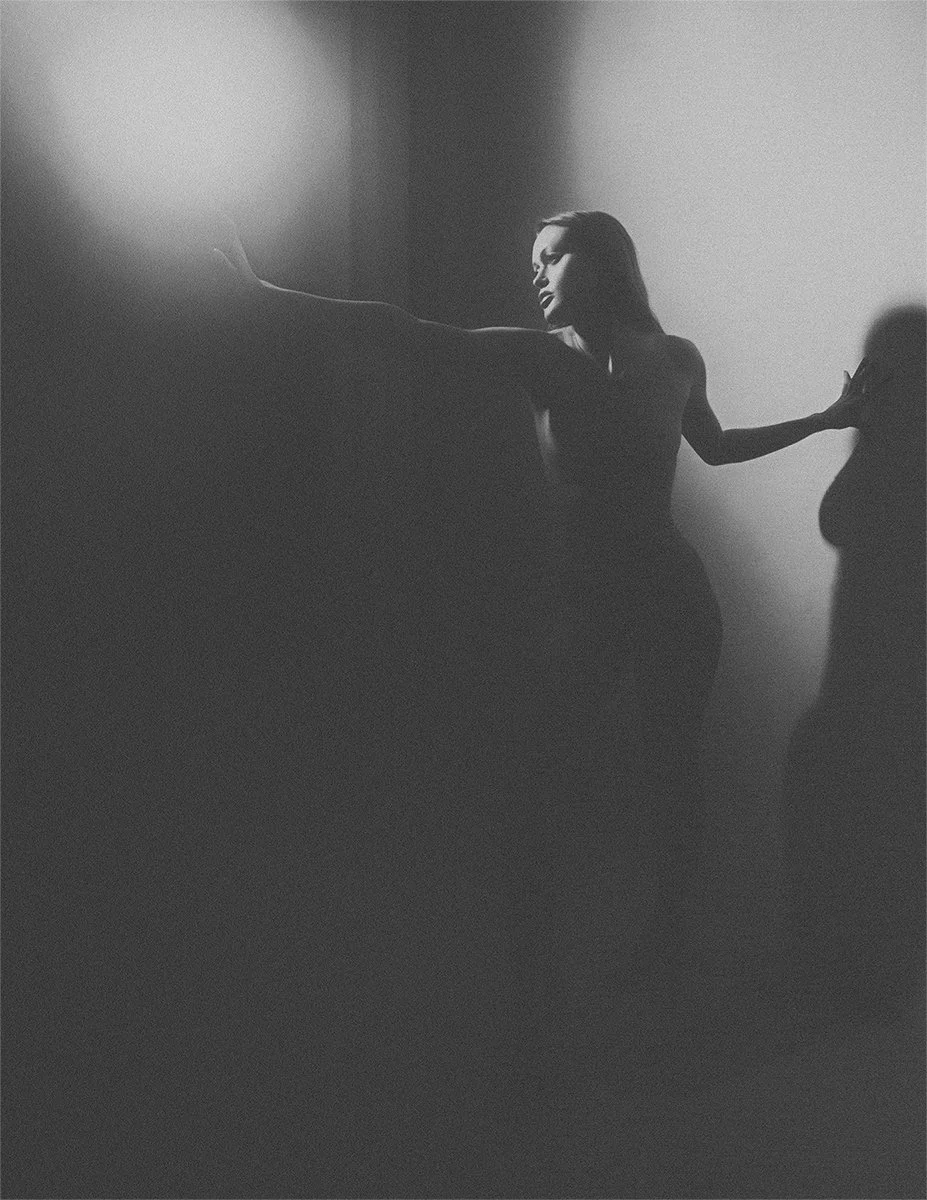
Light is the central instrument. In his own words: "Light enhances but its shadow deletes, thus giving the picture its depth, its third dimension and its subtractive properties." The statement is precise. De Luca's photography reads as sculpture, light and shadow deployed like a scalpel to carve form from darkness.
This is the key to understanding the nudes. The Spaces and Sculptures series, shot in black and white, takes the human body as raw material for geometric investigation. Limbs become arcs. Torsos become volumes. The body loses its biographical identity — its age, its gender as social category, its history — and becomes a three-dimensional object in relationship with light and space. The titles of the series are not incidental: spaces and sculptures. The body occupies space the way a form in a De Chirico piazza occupies space — with absolute clarity and a complete refusal of narrative.
In his nude work, he kept a deliberate distance from eroticism. The viewer is invited to follow the line where light ends and shadow begins, to register the angle at which one form intersects another.
His own account of the creative process confirms this orientation. He describes moving around his subject — literally circling it — until he finds his own frame. The phrasing matters: not the frame, but his own frame. The photograph does not discover the world. It proposes a way of seeing it. "Great photography comes about at the right time," he has said, "but it also needs the right cut that enhances that precise moment." The cut is everything. The crop, the angle, the decision about what the light will do.
He has also stated that photography must feed on both content and form. Neither alone is sufficient. A photograph built entirely on form becomes decoration; one built entirely on content becomes documentation. De Luca wants both held in tension — which is precisely what the nude series achieves. The content is the human body, one of the oldest and most charged subjects in all of art history. The form is geometry, metaphysical and cool. The tension between those two facts is where the work lives.
His portraits of cultural figures — writers, directors, musicians — follow the same structural logic. The face is read as a landscape of form. Mario Luzi, Lina Wertmüller, and Maurizio Costanzo all contributed prefaces or introductory texts to his books, which suggests the depth of his engagement with Italy's literary and artistic world. He was not photographing celebrities from the outside. He was a participant in that culture, documenting it from within.
The architecture photography completes the picture. De Luca approaches buildings the way he approaches bodies — as geometric events in space, subject to the same laws of light and shadow. Naples, Rome, Paris, Dublin, Berlin, Brussels: each city is a new set of forms to circle, to find the right cut for. The subject changes. The method does not.
Personal Considerations
The tale of Augusto’s career, started in the mid-70s, strikes me for its speed. An innate talent and sensibility for composition and the interplay within Light and Shadow was enough to fast-track his career with a starting exhibition in Naples, followed by an incredible trajectory that made him meet the elite of Italian cultural people, directors, actors, musicians and even politicians.
In the 80s he was already on top of the Italian cultural world in a time when my country was yet a cultural actor in the world, before the darkness fallen into this land after the general commodification of every aspect of Italian cultural life. Thus, studying this fellow countryman career seems so much witnessing a life from another country, another world.
But what stands yet is his approach to how he documented the body, keeping him distant from the contemporary example of Helmut Newton, he treated the realism of geometry and the poetry of Light and Shadows that shapes the form.
A great believer that the photography is enhanced by the cut, the crop and the composition, like my late master of Portrait Photography Efrem Raimondi, of the needed balance between content and form, meaning and enhancement of the shape, is a great lesson that can be followed even by us, artistic nude photographers today,
To find a fruitful path to follow between the ruins of the past, in this nightmarish existence, to reach a safe place somewhere far from a reality ruled by those who see only profit and/or power.
Shine on!
Per aspera ad astra