
From the past a source for artistic nude photography future: William Mortensen: The Antichrist of Hollywood
Biography
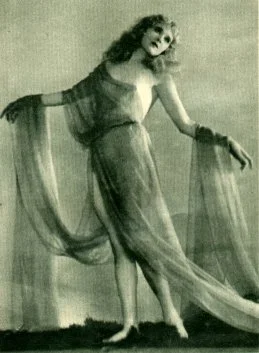
The spirit of spring by William Mortensen. Source: Margaret Livingston. Photo by William Mortensen, as published in June 1927 "Artists & Models" magazine. Scanned from original copy of magazine published with no copyright notice. Original caption: : "An etereal
William Herbert Mortensen was born on January 27, 1897, in Park City, Utah, son of Danish immigrants. Showing early interest in painting, he was trained by his high school teacher before being drafted into the army during World War I. After his discharge he attended the Art Students League in New York, then traveled to Greece to study classical antiquity — only to be told by the League that he had "no talent for drawing." Undeterred, he soon found himself heading to Hollywood in 1921, escorting a young woman named Fay Wray off the train.
In California, Mortensen fell into the orbit of Cecil B. DeMille, working across nearly every department of his productions — painting scenery, crafting masks, shooting costumes. His most consequential innovation came on The King of Kings (1927), where he pioneered the practice of shooting production stills during live action rather than restaging scenes afterward — a method DeMille adopted as standard. He also collaborated with directors Tod Browning and worked alongside Lon Chaney, absorbing from the latter invaluable lessons in prosthetic makeup that would influence his photographic work for the rest of his life.
In 1931 Mortensen left Hollywood and relocated to Laguna Beach, opening a studio and founding the Mortensen School of Photography, which would eventually attract thousands of students worldwide. There he produced what many consider his finest work, writing prolifically alongside collaborator George Dunham — nine books, four pamphlets, and over a hundred articles across three decades. He was awarded the Hood Medal by the Royal Photographic Society in 1949. He died of leukemia on August 12, 1965, largely forgotten by the mainstream art world, a fate engineered in no small part by his great adversary, Ansel Adams.
Photography and Technique
American Grotesque: The Life and Art of William Mortensen with author Larry Lytle from The Philosophical Research Society YouTube channel
Mortensen was a Pictorialist in an era when Pictorialism had become unfashionable. While Ansel Adams and the Group f/64 were consecrating photography as a medium of sharp focus, pure realism and scientific fidelity to the visible world, Mortensen held an opposite conviction: the camera was simply one artistic tool among many, no different in purpose from graphite or clay. What mattered was not the photograph but the picture — the manifestation of something that had first existed in the mind's eye.
To realize these inner visions, he developed a formidable arsenal of darkroom manipulations. Working on bromoil prints, he scratched negatives with razor blades, applied pumice and paints, used texture screens to transform shadows into something resembling charcoal marks or engraving lines, and combined multiple exposures to produce effects closer to Goya or Bosch than to any documentary tradition. The results often read more as etchings or mezzotints than photographs. He also drew on Jungian theory, believing that geometric diagonals and specific proportions could trigger instinctive psychological responses in the viewer — fear, desire, awe — by activating what Jung called the collective unconscious.
His subjects were equally deliberate: witches, demons, monks, Shakespearean figures, nude women in poses that blend eroticism with ritual menace. The nudes in particular occupy a fascinating middle territory — openly sexual yet never pornographic, closer in spirit to Renaissance allegory than to studio glamour. His monk series, where robed figures place female subjects in restraints, simultaneously evokes the Inquisition and foreshadows later sadomasochistic aesthetics, though always filtered through a painterly, almost theatrical sensibility. Mortensen himself was explicit that he was not interested in the occult for its shock value, but as a reservoir of universal symbols — archetypes of fear, desire and sacrifice that speak directly to the unconscious of any viewer.
His theoretical writings, particularly The Command to Look and Monsters & Madonnas, formalized these ideas. The first title says everything about his core belief: a great image does not merely reward attention, it compels it. This conviction, rooted in his Hollywood years among showmen like DeMille and Browning, made him as much a psychologist of the gaze as a technician of the darkroom.
Marginalized during his lifetime by the purist establishment — Adams famously called him "the Antichrist" — Mortensen was largely written out of photographic history until a gradual rehabilitation began in the 1980s. The 2012 Metropolitan Museum exhibition Faking It: Manipulated Photography Before Photoshop and the 2014 publication of American Grotesque finally restored him to serious critical consideration, positioning him as a direct precursor to the digitally manipulated image-making that now dominates visual culture.
Personal considerations
Ansel Adams Literally Had This Photographer Removed From the History Books from ZACH DOBSON PHOTO YouTube channel
William Mortensen, the major pictorialist photographer of the 30s, banished from photography history books for marketing reasons by group f/64 leaded by Ansel Adams is a fascinating tale.
Having worked in Hollywood in the 20s, the bigger name in the industry was surely Mortensen, but before that time it was technically difficult to obtain sharper and more defined images. As said in several articles in this series: lenses started becaming faster and film roll emulsions more sensible with a finer grain in the 30s of the XX century, thus, the alternative to portrait the world as really appeared was possible and with that a whole host of economic applications of the medium.
There was, thus, a push for recognizing a kind of Photography capable of shooting products, buildings, industrial implants and other so real things to shoot, with paying clients behind them. In the 60s, arriving to end of Mortensen life, he was pretty much forgotten. But not his art, that in recent years as known a rediscovery and a return of appreciation.
After all, what real reason stands in the damnatio memoriae imposed by Adams to Mortensen? His way of modify heavily his images? Really? Adam’s zone system is an exposition range enlargement system that required a lot of work in darkroom too and even in Adam’s writings it is not said silly things like “real photos are made without much work in post-production”, on the contrary.
Mortensen used razor blades and pumice stones to carve texture on the negative? Yes, and the other invented the burn and dodge technique, counterfeiting the image “as appeared at the moment of shooting it” as well.
But there is one discussion point that baffles me the most: who cares what subject one shoots, really? One prefers flowers and churches, if not spirit bottles and the new car manufacturer factory, marvelous! But this doesn’t add or does not take away anything to one that – instead – prefer to evoke in his images emotions and human archetypes, inspired Carl Gustav Jung psychology books, and vice versa.
One could have more of a commercial use, the other more artistic. Yeah, Mortensen was the artist there, he has always been such a human being, the others where more technicians. Ok, so what?
For what concerns us contemporaries, frankly, try be more like Mortensen – surely this is what I want to do this. It would be useful reading even his two more famous essays: Monsters and Madonnas and The command to look.
Nowadays, the more applied, famous, and ever copied aproach to photography is the sharp, defined, technical correct type of images that must be fight against. The pendulum must shift direction now.
After all, in the age of the emerging generative AI, what can you think is more difficult to replicate by machine learning tools?
Exactly! It is the Art, the last bastion, the last hope for human creative economic recognition. The commercial photography is doomed by the market rules and all the clients that will be given the opportunity to not paying photographers to have the images that they need for their business, well, they will just take it.
I warned you.
Shine on!