
Twilight of the Art Nude photography genre: Jock Sturges — Photographer of the Naturist World
Biography
John Sturges, universally known as Jock, was born in New York in 1947. Facing the classic dilemma of his generation upon graduating high school in 1966 — college, Vietnam, or draft evasion — he chose a fourth path: voluntary enlistment in the U.S. Navy. The choice proved formative. Stationed in Japan, he served four years as a Russian language communications specialist, and already drawn to photography, he taught it at base facilities and eventually served as official base photographer. He left the Navy in 1970 with a broadened worldview and a clear artistic direction.
Episode 71 - Photographer, Jock Sturges (USA + France) on the Wise Fool Podcast from the Matthew Dols talks Art YouTube channel
He enrolled directly at Marlboro College in southern Vermont, where an interdisciplinary program led him to a BFA combining Perceptual Psychology and Photography, working alongside psychologists from Cornell and photographer Richard Benson. After graduating he remained in Vermont for several years, working in the local school system, as a paramedic, and as a trip leader to Russia and Japan for the Experiment in International Living. In 1972 — a key turning point — he made the decisive shift to large format 8x10 view camera photography, beginning what would become his life's defining artistic project.
He spent a year working for Richard Benson in Newport, Rhode Island, printing the negatives of masters such as Eugène Atget, Paul Strand, Garry Winogrand and Lisette Model — an immersion in photographic history that shaped his aesthetic sensibility deeply. In 1978 he relocated permanently to San Francisco, where he would live at the same address for over two decades. He obtained his MFA from the San Francisco Art Institute in 1985 — an institution he described, with characteristic dry wit, as "the least useful thing I have ever done to eight thousand dollars." He later moved to Seattle with his wife Maia, a medical student, before eventually returning to work primarily from France, which had by then become a true second home. At the time of writing he lives and works between San Francisco and France.
Photographic Approach, Subjects and Work
Jock Sturges: Photos of Fanny, Montalivet, France over the years from bcfein123 YouTube channel
Sturges's work is rooted in the long-term documentary tradition: he photographed the same families, and the same individuals, over spans of decades, tracking their physical and personal transformation from childhood through adolescence and into adulthood. His primary locations were naturist communities in Northern California and, above all, the CHM Montalivet resort on the Atlantic coast of France in the Gascogne region, where he returned almost every late summer for years. He also worked extensively on the West Coast of Ireland and on East Coast beaches in Rhode Island. His commercial work — confined deliberately to winter months — covered classical dance, fashion and portraiture, leaving his summers entirely free for personal projects.
His most emblematic subject is Misty Dawn, a California resident he photographed from early childhood through her twenties, whose portrait spans multiple books and represents most completely his vision of extended, life-long photographic relationship with his subjects. She appears on the cover of Radiant Identities (1994), his second major monograph.
Technically, Sturges is inseparable from his 8x10 large format view camera, adopted in 1972 and used consistently throughout his career. The format imposes long exposure times, requiring subjects to hold still, and produces images of exceptional tonal richness and detail. He has experimented with digital photography and, later in his career, documented a dedicated project with Rollei medium format equipment (The Rollei Project, 2013) and another with a Leica (The Leica Project, 2019), but film and large format remain his foundation. His aesthetic draws consciously from classical photography and from nineteenth and early twentieth century painting.
Sturges himself describes his images as deliberately neutral — unhurried, still, and formally composed. He attributes this quality partly to the technical constraints of his camera, and partly to a conceptual framework rooted in his perceptual psychology studies: he seeks to observe and render subjects in their natural context without imposing interpretation. Despite the physical presence of a large and imposing camera, he consistently achieves a remarkable atmosphere of intimacy and ease in his subjects — families and individuals photographed in conditions of genuine trust built over many years.
His work is held in the collections of major international institutions including MoMA and the Metropolitan Museum of Art in New York, the Bibliothèque Nationale in Paris, and the Frankfurt Museum of Modern Art. He has been represented by up to 25 galleries across eight countries, and his publications — primarily with Aperture, Scalo, and Steidl — span over three decades, from The Last Day of Summer (Aperture, 1991) to The Leica Project (2019).
Personal considerations
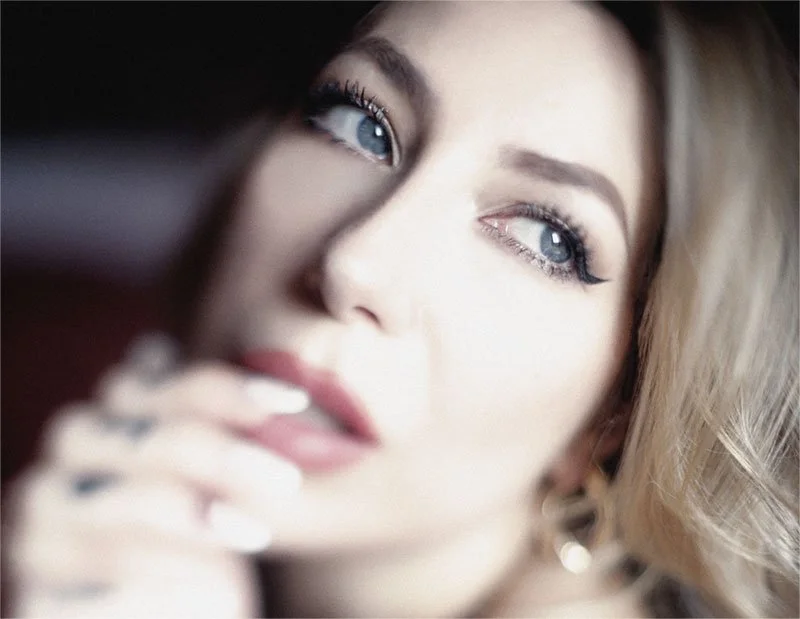
Naomi in a 2024 experimental shooting; ph: Francesco Coppola
As we have seen then, this author, with his formation in photography and in psychology too followed a different path from the more creative photographer treated in the previous articles. No shoot through softness like David Hamilton, no moody chiaroscuro images like Bill Henson, but instead a neutral vision of photos reproducing shapes and relationships, moods, mostly like they were in real life.
Important here is to consider the core photography interest in capturing memories as a person or a community lives during their growth, and those communities with which he collaborated were of naturist nature, thus people that have not the same perception of shame in exposing their body in full nudity, at least in hot summer days, neither for the young, nor for the elders.
Having inserted Sturges in the twilight section of the artistic nude history we have to face now the controversies he encountered starting in 1990, when his San Francisco studio was raided by FBI agents and his equipment seized. Subsequently California’s legal system declined to bring an indictment against him. In 1998, unsuccessful attempts were made to have his books The Last Day of Summer and Radiant Identities classed as child pornography in Arkansas and Louisiana. Customers in Alabama and Tennessee sued Barnes & Noble for stocking the books, resulting in protests throughout the United States.
In this specific case we can conclude that, while Sturge’s photographic experience stemmed from documenting (in the most literal sense of the word) the life of these communities that could be broadly described as part of the hippie movement, the protests he had to face came from the emerging conservative extremism in American society that stands against minorities and women rights, against science, contesting the evolution theory’s validity based more on their personal feelings than factual basis, promoting the return of a “moralistic society” guided by priests and powerful VIPs posing as “chosen by god”.
Nothing real, nothing serious – at least in the facts accounting – Sturges work isn’t one that I feel particularly near to me, aside from the tendency that I share with him to work in continuity with the models I have already shot, leaving them free to express themselves with little posing guidance.
His 8x10 work is surely stunning and should be seen printed on the wall, because no screen can render the richness of details and tonal ranges such a large negative can give, these technicalities indeed could be a key to reunite contemporary Photography to Painting, Sculpture, Drawing and the other more established media of Art expression, something that is nowadays in serious crisis.
Shine on!