
A moment of improved clarity in my fine art photography practice
What the shadow knows
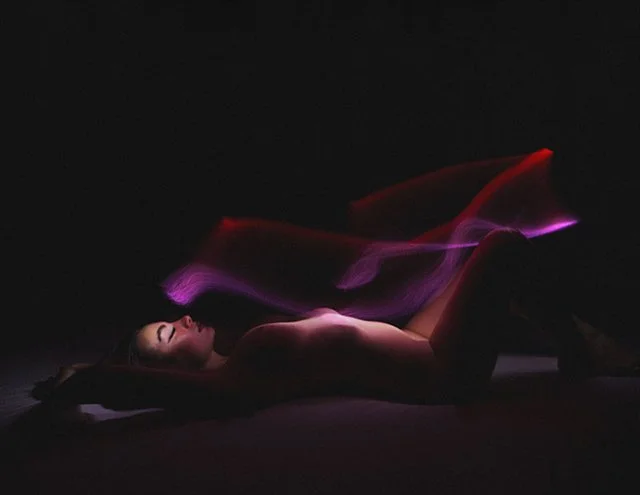
Her Dreams; ph: Francesco Coppola https://www.saatchiart.com/en-it/print/Photography-Her-dreams/2964407/13697425/view
There is a clarity that arrives only after the fact. You shoot, you edit, you look and somewhere in that sequence – if you are fortunate – something that was instinct becomes understanding. A moment of realization.
That happened to me this past week, working through the first edits from a recent light painting session. Looking at the images coming out of that shoot, I found myself able to name, perhaps for the first time with real precision, what I have been doing all along.
What my imagery does not offer
The model in my images does not appear to provoke carnal desire. She is not there to be remembered as a person, documented in the way a portrait documents. Her expression, her gaze, the mood carried in her face, none of these are the primary instruments of meaning in what I make.
I am not interested in the model looking at the camera, or at anything in particular. I am interested in what her body does in darkness, in motion, in time. Artists in various media have been telling us for some time now: body talks.
This is a deliberate departure from most of what nude photography too often is assumed to be. The conventional nude photograph either aestheticizes the body for desire, or records it for memory. Both of these are legitimate things to do. Neither is what I am after.
Gesture, shadow, fragment
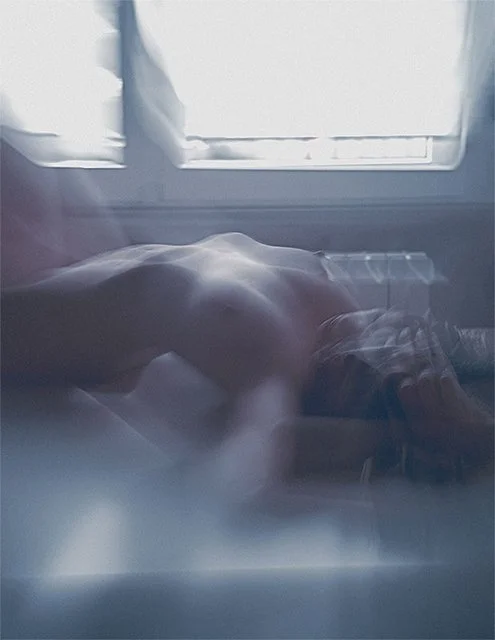
Dopamine Rush; ph: Francesco Coppola https://www.saatchiart.com/en-it/print/Photography-Dopamine-rush/2964407/13727679/view
What I am after is closer to this: a gesture captured in long exposure. A figure told by shadow more than by light. A detail of the body that carries weight: psychological, symbolic if not mythological, without requiring a face to anchor it.
The light painting technique makes this visible in a particular way. The light source moves during the exposure, leaving traces: brushstrokes, arcs, calligraphic sweeps of color against darkness. The figure is not illuminated so much as visited by light, briefly, incompletely. What remains is partial. What is partial invites the eye to complete it, and that act of completion is where the psychological register of the image lives.
This is not a new idea. It has a lineage. The Pictorialists (Demachy, Holland Day) deliberately softened and obscured the figure, resisting the documentary clarity that straight photography could deliver, because they understood that what is withheld can carry as much meaning as what is shown. Bill Brandt's late nudes push the body toward landscape, toward abstraction, until the human form becomes something stranger and harder to categorize. Lucien Clergue's nude figures dissolve into Mediterranean water and light. The boundary between body and element barely held. In each case, the choice to surrender legibility is the choice that opens the image to something beyond mechanical record.
What darkness does on paper
There is also a practical intuition here, one that a screen obscures: shadow holds differently on print.
A monitor is a light source. It fills dark areas with its own glow, flattening and brightening what was intended to be deep. Matte fine art paper does not do this. On the right paper, black is not the absence of information, it is texture, depth, a presence the eye moves through rather than past. Images that read as underexposed on a backlit screen can open up entirely in print, revealing gradations in the dark that the monitor simply cannot show.
This is one reason I consider printing non-negotiable, as I wrote last week. But it is also a reason to trust the darkness in these images rather than correct it. The shadow is not a flaw to recover. It is where the work lives.
Nyx
The images from this recent session, that I am sending today to the London Photo Show open call, I have titled Nyx, after the Greek goddess of night: born from the primeval chaotic darkness, feared by Zeus himself. It is a title and the interpretation key.
A viewer or collector approaching these images needs to know that the darkness is a vocabulary, not an accident. Nyx provides that. She is primordial, pre-rational, the condition under which everything else becomes possible, or suspends its course at her will. The way I lighted the model’s body, so partial and incomplete, is not a failure of lighting. It is my point.
A practice becoming clearer
I said at the beginning that my awareness arrives after the fact. What I mean is this: I did not plan to make images that work this way. I discovered it by making them, and I am still discovering what it means.
But there is a satisfaction in being able to name it: shadow, gesture, fragment, the body as hieroglyph rather than likeness, and to see that it connects to a tradition, that others before me understood what it means to choose incompleteness over legibility, and made extraordinary work from that choice.
Like the surrealists
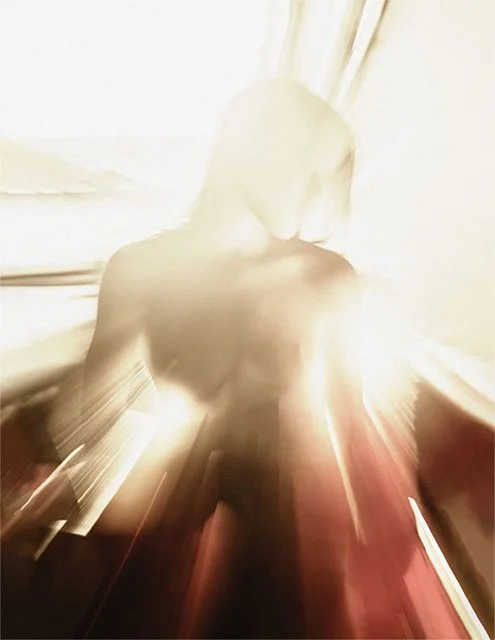
Queen of hearts; ph: Francesco Coppola https://www.saatchiart.com/en-it/print/Photography-Queen-of-hearts/2964407/13727199/view
Like Man Ray and the other signatories of the surrealist manifesto, who rejected the idea that rationality alone could yield true understanding of the world and human relationships, I too reject the notion that a static frame, a technically precise portrait, and every traditional description of how women are and behave can pierce the seven veils of appearance to truly know who they really are.
Look, the technicality is one aspect, one layer, but in my mind, there is a wound, one through which it rains all the time. Truth moves. People change. Interests, ways of looking at things, the list of one's priorities — all of these stand under Society's influence, and for some time now that influence has become ubiquitously hostile.
This inner winter of mine is mediated by the technical choices I make and how I execute them. As with the color, out-of-focus images from Paolo Roversi, which unlock colors and with them mood, what I am trying to do in this phase of my artistic image production is freeing meaning, mood, feelings by distancing myself from details, sharpness, contrast, and all the other empty characteristics of a technically correct but definitely shallow image.
I am not saying here that my artworks are perfect and that I am achieving my artistic goals — it is not up to me to state this. Now, to all of you that have read this post, the invitation to look at my production, on Saatchi Art mostly, on the cover images of my articles, on the rare occasions I use my own work rather than historical references. If you can, on the magazines too, and evaluate if images, titles, descriptions, move something into you. If it does, then I will know that I am doing something coherently good.
That, for now, is where I am.
Shine on!