
Biography
Paolo Roversi’s Studio Luce exhibition in Ravenna presentation, by Comune di Ravenna YouTube channel.
The beginnings: born in Ravenna in 1947, the last capital of the western roman empire, our hero grown up between the frequent fogs of that piece of Emilia Romagna and the Galla Placidia’s mausoleum mosaics, until all the school years and even after some time in which he was enrolled at university.
He tried writing lyrics, but also to see if the Theatre or Cinema world could be his destiny before falling in love with Photography during a family trip in Spain in 1966. It was, after all, the Italy between late 60s and early 70s and every road simpler to follow and open to access by someone with the right skills, a first world reality very different from our third world reality.
Returned from that Spanish trip Roversi converted his family’s cellar into a darkroom, beginning to bathe his hands in the development chemicals and being progressively fascinated by the alchemical procedure of developing and printing images in the dark. After that he started an apprenticeship period with a local ceremony photographer Nevio Natali and started working for Associated Press, for which he covered Ezra Pound’s funerals in Venice and in 1970 he opened his first studio for Portrait work.
The move to Paris: by pure chance he met in 1971 Peter Knapp, that at the time was the creative director of Elle magazine, showing his photos to him, with such a good result that Knapp warmly suggested him to move to Paris. This happened on a rainy November evening in 1973.
There he started searching to be hired as assistant from photographers like Helmut Newton and Guy Burdin but ending to work for photographer Laurence Sackman by the day, by night he worked in the kitchen of his rented flat to make Still Lifes and making with them a portfolio, obtaining shortly after his first publications on Dépêche Mode, Elle and Marie Claire.
Tools and muses: it is in 1980, in the Pin-up studio, when he meets for the first time and falls in love with the Polaroid 20x25 camera, the large format strip instant film camera often used at that time to have a quick-ish pre-visualization of the final image, but for him that was one of his creative tools, the others were all Large Format Deardorff cameras.
With those tools he has been able to meet and work with many collaborators and the major models of the 80s, muses like Naomi Campbell, Kate Moss and in more recent times the singer Rihanna, touching and firmly resting on the apex of his career, working for the Fashion business and often practicing nude photography with his varied but often pictorial approach.
The legacy: in the 80s, 90s, 2000s and 2010s he worked with numerous fashion stylists, the likes between others: Giorgio Armani, Yohji Yamamoto, Valentino, Krizia, Dior, Yves Saint Laurent, Alberta Ferretti, Hermes.
He even produced, starting from 1985, more than a dozen of books, obtained numerous awards often become exhibitions, since 1989 Una donna that was a book and exhibitions from him – this until the last one, Birds performed at Dallas Contemporary of 2021
He also has been commissioned the 2020 edition of the famous Calendario Pirelli.
His Photography
Paolo Roversi on the set, from
Christian Dior YouTube channel
During his long career Roversi portrays women and men for the Fashion industry, without ignoring more defined and sculpture like looks, but more often playing with the image like a painter, inserting techniques like controlled movements or overexposures, shooting without strobes and often with long exposures, playing with the unpredictable colors of instant large format film.
The shoots happened always in a studio, and often the studio was in his home, or his home was the studio. Much contrary to what a Helmut Newton believed and did, his rooms were the larger than world ecosystem where models came to him to reveal themselves, with trust and appreciation.
His exhibition, Storie, that I personally visited at Palazzo Reale of Milano in 2017 offered to the viewer his varied approach, ranging from hyper-realistic super detailed small printed portraits, to gargantuan size images of “dancing” nymphs, beautifully blurred dressed in red drapes, showing that concepts, ideas and feelings does not require strict rules to be transmitted to the onlookers, but they do need the proper look.
Surely those Deardorff can be printed in a wide varied format, from postcards to billboards, and the chemicals colors, like his red is yet unmatched from anything that any digital media can produce. It is the Large Format advantage that kept film alive during the digital era, after all: owners of industrial facilities and the Fashion business needed that extreme details, depth of colors and separation of planes that no other type of camera can give.
Personal considerations
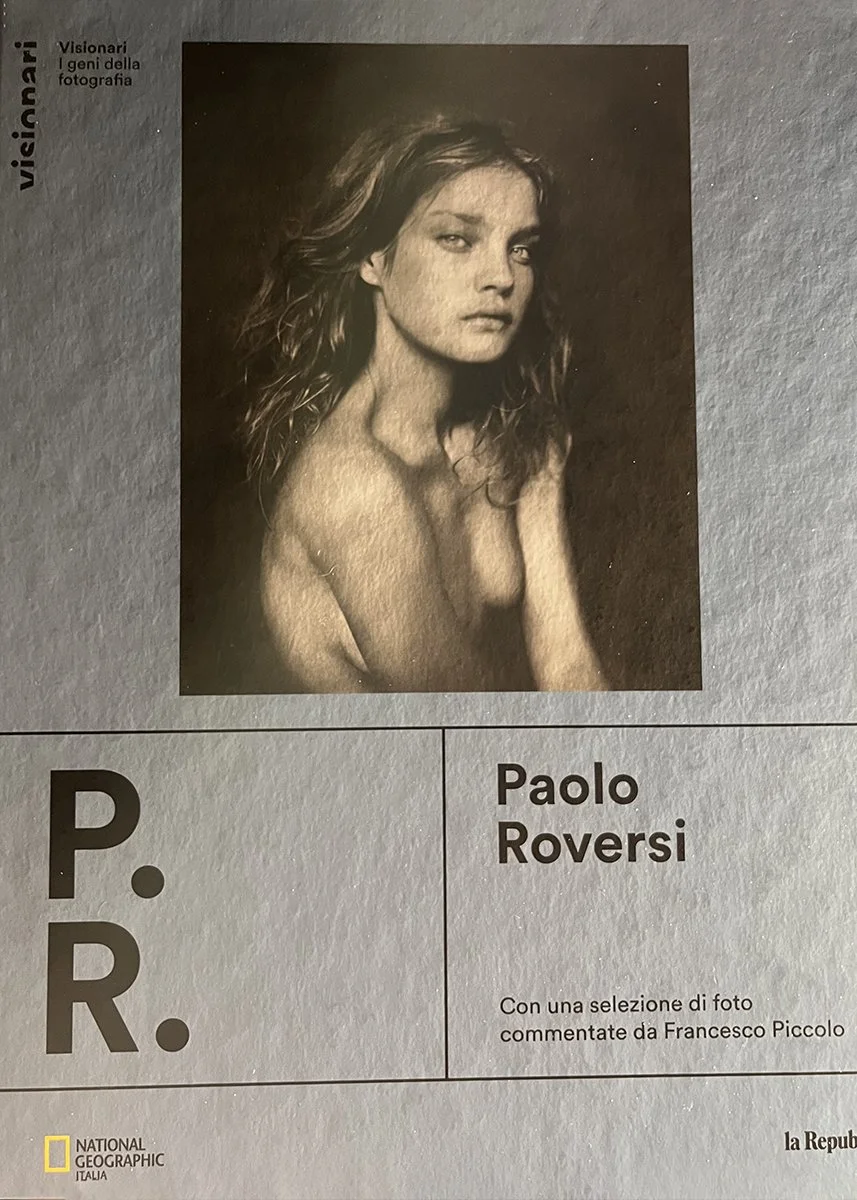
I Visionari - I geni della Fotografia: Paolo Roversi, National Geographic Italia and La Repubblica: personal copy owned by me.
Many things can be noticed from the life and work of Paolo Roversi. As previously written, entering – so fast, so soon – in an established photographer as an assistant is a nonexistent thing in Italy, I don’t know in the other countries, but in nowadays Italy that is a long gone away thing.
I mean, we have an abundance of pricy photography academies, but even spending those 12 or more thousand of euros and expending a nine month of nonstop training will guarantee a career to anyone. After all, techniques can be taught and acquired in due time and practice, but what one can do with them without marvel, or wounds, seeded deep inside their existence?
Another highlight that comes to my mind, luckily Roversi stayed in Paris, where he had that full creative freedom to exert his visions, no matter if blurred, overexposed or else. In USA in the 80s he would have met, most probably, the hostility of the last descendants of the club f/64 sect and their abhorrence of not sharp, not highly contrasty, not super defined every time images.
His nude work would have fared no better there. Paris was, is, and hopefully will always be welcoming artistic depiction of nudity, if performed as the more pristine and elegant type of portrait, taken to show the soul of the subject, not only her exterior beauty.
And from the decayed 2026 Italy, where a troubled visionary receives not the advice to move to Paris but to take part in as many public selections from some statal “stable” job, I can only add, that the living, majestic, example of Paolo Roversi career and approach to Photography is a more useful lighthouse in the dark, our darkened time, to overcome the odds, avoid generative AI competition and being able to build, with a good English and a good internet connection, a photographic career as an artistic photographer.
Shine on!