
Antoine D'Agata: Between Contrast and Social Activism
Biography
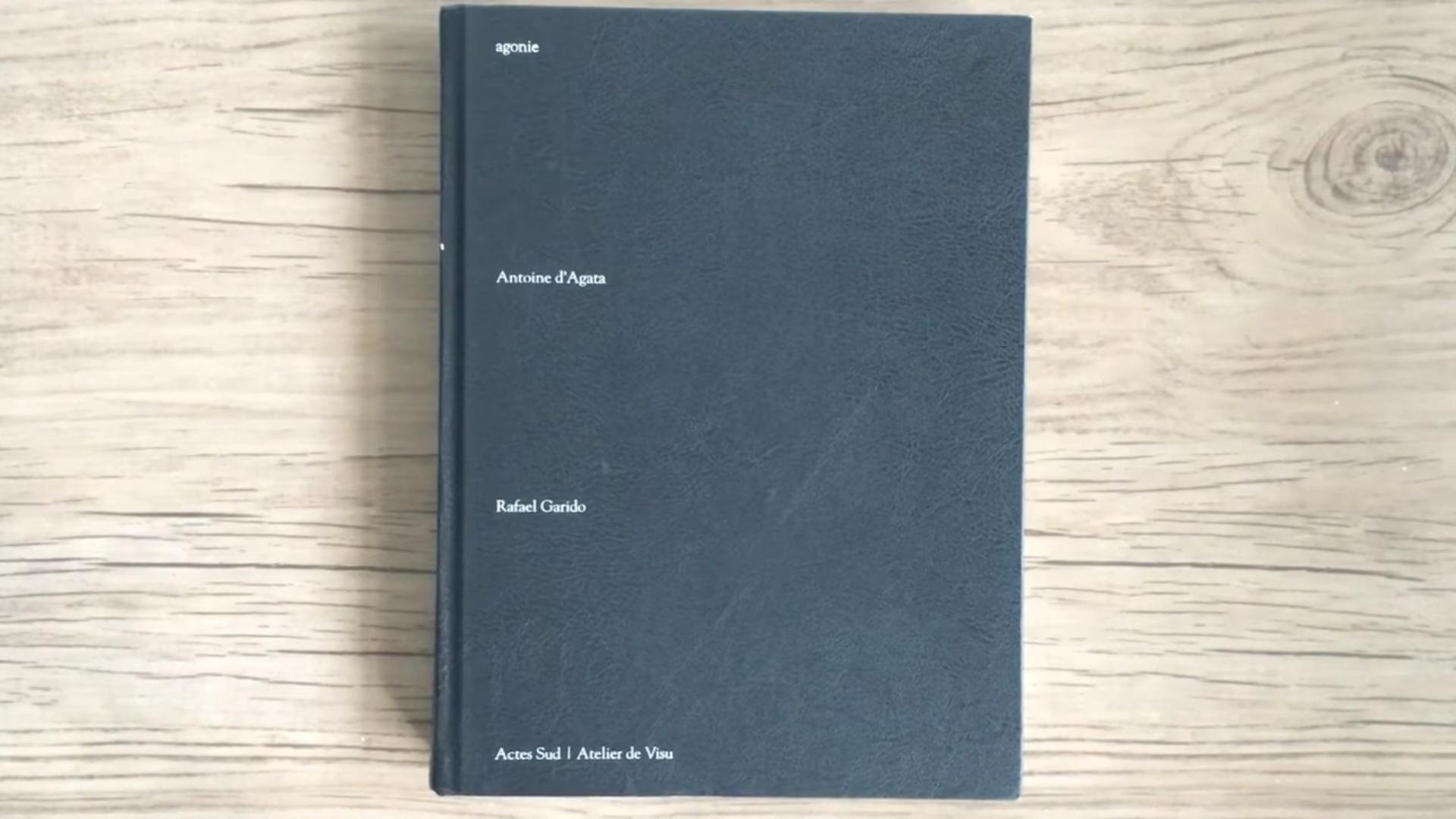
ANTOINE d’AGATA & RAFAEL GARIDO Agonie by Rafael Bosco Vieira YouTube channel.
Antoine D'Agata was born in Marseille in 1961. At seventeen, he encountered the punk and anarchist movements in his native city and began frequenting brothels and using drugs. In 1981, at age twenty, he lost the use of his left eye after being struck by a police tear-gas grenade during a confrontation with neo-fascist members of the Parti des forces nouvelles.
This permanent partial blindness would later become instrumental to his photographic vision, creating a flattened perspective remarkably close to the lens of a camera.
In 1983, D'Agata left France and spent the next decade traveling. He arrived in New York in 1990 and enrolled at the International Center of Photography, studying under Larry Clark and Nan Goldin. Between 1991 and 1992, he worked as an intern in the editorial department of Magnum Photos. Upon returning to France in 1993, he took a deliberate four-year break from photography, stepping away from the medium entirely.
His return to practice came in 1998 with the publication of his first two books, De Mala Muerte and Mala Noche. These works introduced the visual language that would define his practice: intimate, contaminated, present. In 2001, he published Hometown and won the Niépce Prize for young photographers, an early recognition that his work occupied a distinct and significant position. Throughout the early 2000s, he published with steady intensity: Vortex and Insomnia in 2003, Stigma in 2004, and Manifeste in 2005. In 2004, he joined Magnum Photos as a full member, a move that provoked considerable tension within the institution, as his approach to photography fundamentally challenged the documentary distance that photojournalism had traditionally maintained.
Since 2005, D'Agata has had no fixed place of residence, living in perpetual motion across the globe. This nomadic existence became integral to his methodology, allowing him to maintain proximity to the situations and people he photographs without the anchor of home or security. In 2004, he made his first short film, Le Ventre du Monde, inspired by Georges Bataille's Madame Edwarda. This led to his feature film Aka Ana, shot in Tokyo in 2006, and later Atlas, filmed in 2013. Both films extended his photographic philosophy into cinema, deepening his investigation of desire, transgression, and human fragility.
More recently, during the COVID-19 pandemic, D'Agata documented the crisis in France using thermal imaging technology. This body of work, variously titled VIRUS or Contagion, represents another evolution in his visual approach, stripping away conventional aesthetics to render human subjects as pure heat signatures, reducing them to their essence of life itself, stripped of cultural specificity.
Approach and Technique
Interview with photographer Antoine D' Agata, excerpt of the interview by Tommaso Lusena e Giuseppe Schillaci from Tiago Figueiredo YouTube Channel
D'Agata's fundamental principle is that photography must emerge from necessity rather than imagination. He does not begin with a preconceived aesthetic or compositional strategy. Instead, he enters situations guided by his unconscious obsessions: darkness, desire, fragility, the sexual act, allowing the work to emerge from his relationship with existence itself.
His early photographic practice relied on small-format cameras, primarily the Leica, which allowed for mobility and intimacy. He also worked with Polaroids and disposable cameras, employing both film and digital formats in black and white and color. What distinguished his approach was his refusal to hide within technical perfection. Being physically present within the action mattered far more than achieving beautiful composition. He often shot without looking through the viewfinder, prioritizing proximity and contamination over control.
Central to his work is the concept of the photographer as actor rather than observer. He does not document situations from a distance; he becomes part of them, introducing his own desire, his own body, his own presence into the frame. This refusal of documentary distance is what makes his work transgressive. In his nude photography particularly, he photographs subjects with whom he has emotional and sexual relationships. There is no false separation between the photographer and the photographed. The image emerges from lived experience, from desire, from love.
His visual language in these early works is characterized by blur, movement, and apparent chaos. This blur is not accident; it is philosophical. It is a refusal to pretend that perfect focus and refined composition can honestly represent human fragility and desire. The blur becomes the visual correlate of his ethical position: presence matters more than beauty.
As his work evolved, particularly in his films, D'Agata moved toward sharper, clearer imagery. He found the blur claustrophobic, limiting. Yet even as his images became formally clearer, his approach remained fundamentally the same: to achieve intensity and madness without retreating into aesthetic comfort. In his most recent work with thermal imaging, he has gone further still, abandoning conventional aesthetics altogether. The thermal camera reduces all subjects to temperature, to heat, to the most basic evidence of life. In this reduction, there is a kind of ultimate honesty: no room for the photographer's artistic intervention, only the presence or absence of human warmth.
Throughout all these variations, D'Agata's method remains rooted in ethical rather than aesthetic concerns. His work insists that the most important thing is not how something looks, but what it means to be present with it.
Personal Conclusions
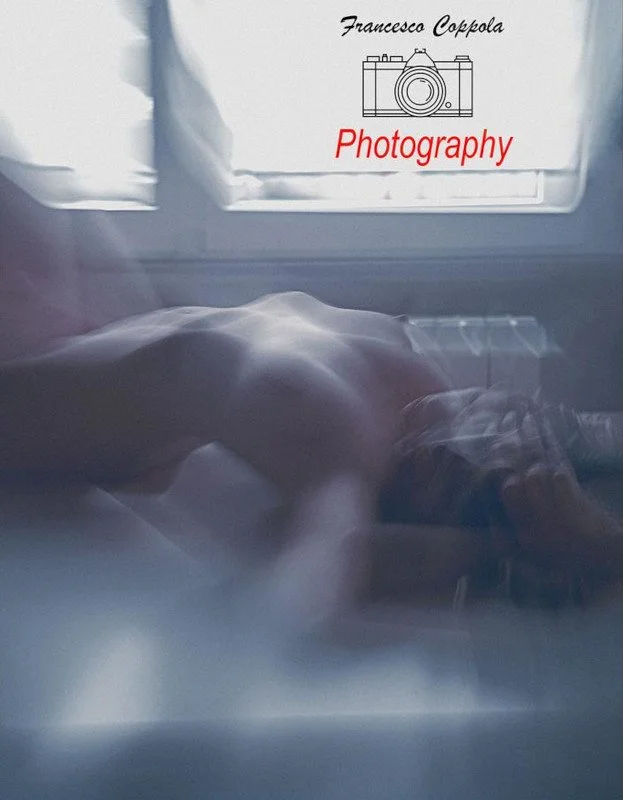
Dopamine Rush; ph: Francesco Coppola
I am coming to this author by suggestion of my mentor because some of my production reminded her of his early works. I can't figure out why he didn't appear in my researches for the series of essays about the history of fine art nude photography. Anyway, I see what she meant now, and discussing D'Agata's production, what is similar and what is really different, will be exactly what I need to focus better on my own image making. So let us proceed with the task at hand.
It is difficult finding a figure more contrasting and full of contradictions as D'Agata, and this makes him and his work hard to frame. I would advise against judging him only because he was a drug user, involved with prostitution, and talked often of madness.
His idea of "madness" isn't, for starters, the loss of control. On the contrary, he refers in many interviews to a focused and controlled madness. It is the madness of believing that dreams and imagination are real forces that constrain one's way of doing things.
He pushed himself hard against anything that could dull his will and senses. Even photography, when after twenty years of practice it became too easy to him, he pushed forward into video making.
One might mistake his approach for mere instinct, casual picture-taking by inserting himself into scenes. But nothing could be further from the truth. He studied formally under Clark and Goldin. His is a rigorously philosophical and ethical practice, yes, I say this with a straight face: an ethical attitude.
He, like me, concluded that a defined, pristine, contrasted image of a human subject cannot define that subject's emotions, impulses, desires. In this mental approach we collide wholly.
His lovemaking with prostitutes and AIDS-afflicted women in Japan has a carnal and impulsive trait, maybe, but at the same time it is an act of love for the excluded of the world, the ones that societies prefer not to look at or know about.
This is same photographer who was able to photograph with a thermal camera a dying patient dignified by the embrace of a nurse: he gives one last act of humanity to permit the despised ones, the excluded ones, to know they are part of Human family. Their dissolving into emptiness cannot be avoided, but it will not pass silently or unnoticed. We can mourn our unlucky sisters and brothers together with him, thanks to him.
This is ethics. I stand by it.
Yes, some of my artworks align with some of his, because both of us arrived at a philosophical assumption about portraying people's inner sides.
Another possible coinciding point: my carnal side is also vehement (the vehemence of a sapiosexual, you see) and it has manifested once, in what are nowadays pretty dusty if not rusty times, as curative. One focused on making my partner happy.
But here we start the difference: I am a child of a different time and social situation. D'Agata can be considered one of the last representatives of the transgression era, the one that started toward the end of the '60s and bloomed in the '80s, expressed aptly by photographers like Helmut Newton. The era we are immersed in today is totally different. An era of large swaths of population left behind by late capitalism, where relationships are fluid, couples are fragile, and cradles are pretty empty.
In the wave of loneliness I swim, immersed up to the neck. For us, involuntary celibs, it would be transgressive to return to the monogamous couple that endures for life and can have a house, children, a career.
I remember a long stretch of this other life, when I was in a couple and it was all a dance of sparks and fires, an orgonic battery our couple was, weather forecast ruiner, cloud breaker, tempest bringer. Divine in my giving everything, my best.
Sapiosexual means, I need a woman to light my mind, not only being alluring in appearance, but an accomplice in artistic crime, one with whom we can stay near all the time, not a woman who travels constantly from city to city, nation to nation for work. Or at least, if I can travel with her for my work, that could work too.
I am a radical romantic, not by ethical or moral choice: it is how I have been since birth, when I had to carry around a badly managed medical condition that put a barrier between me and the girls I met.
This is the motivation for the next difference with D'Agata: I could never seek sexual interactions with my subjects. They are professional collaborators or dear friends, but my sexuality is not engaged in such situations, even if I am alone with a naked model.
No, my subjects are the girls I desired in the past that I couldn't reach. The love finally obtained and explosive. The love dead and gone, the wave of loneliness and ghosts of the past that haunt me. This is my search. This is who I am.
A romantic as always I have been, then, I am. Just older and embittered.
That's all!
Shine on