
Transitional Authors 6: Ruth Bernhard
Introduction
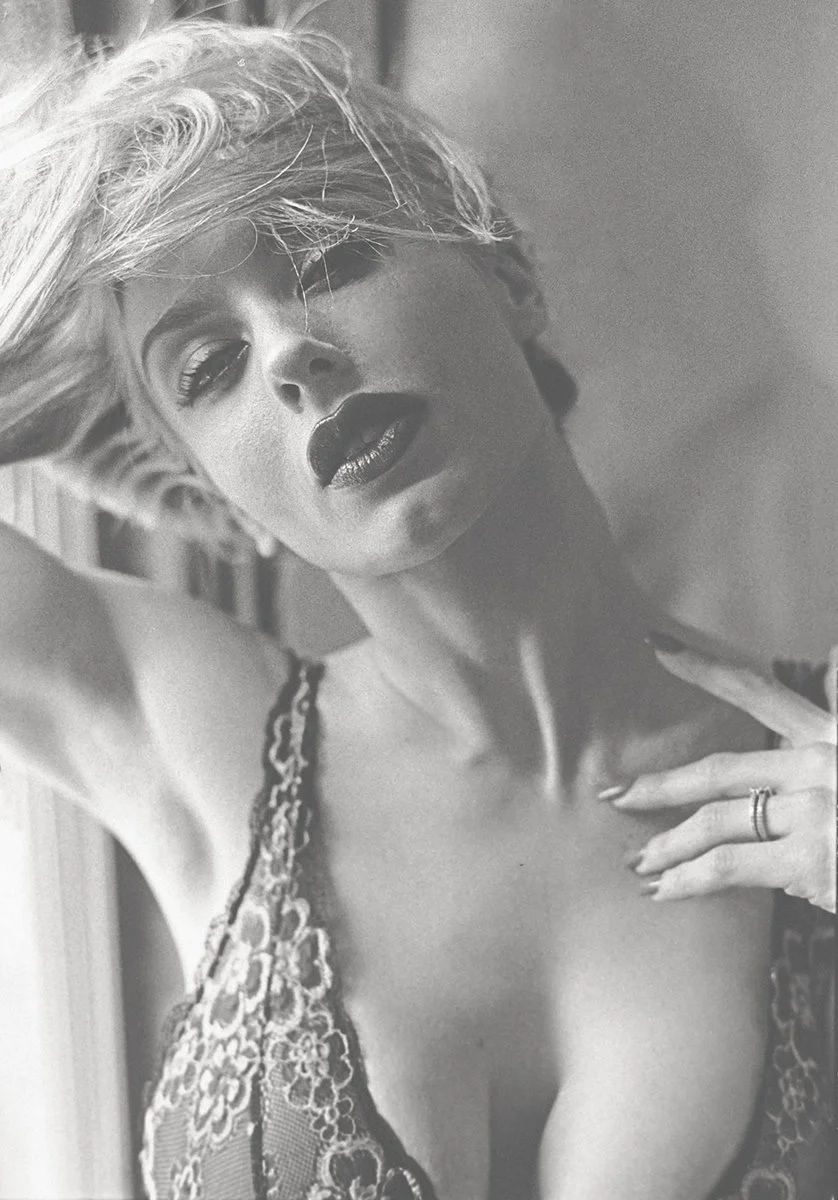
Lorenza Caradonna in HP5+; ph: Francesco Coppola
As before said: maybe treating two authors with similar art trajectory and approach to art nude photography creates somehow a prospective error. That is why I decided now to talk about two different authors, two women – Ruth Bernhard and Diane Arbus – that had a great impact into this genre but with a different way to shoot nude subjects.
Let’s delve into the first hero of our photo-history series.
Ruth Bernhard biography
Born in Berlin on October 14, 1905, Ruth Bernhard was the daughter of Lucian Bernhard, the renowned graphic designer known as "the father of the German poster." Her parents divorced when she was two, and she was raised by two schoolteacher sisters and their mother, though her father remained a supportive influence throughout her life.
After studying typography and art history at the Berlin Academy of Art from 1925 to 1927, Bernhard emigrated to New York City at age twenty-two to join her father. Her photographic career began almost by accident—working briefly as a darkroom assistant for photographer Ralph Steiner, she was dismissed for poor performance. Using her severance pay, she purchased her first camera, an 8x10 format, in 1928.
Her breakthrough came in 1930 with "Lifesavers," an abstract composition that caught the attention of Vogue's art director, Dr. M.F. Agha. Publication in Advertising Art magazine followed in 1931, launching her into commercial photography and industrial design work. In 1934, the Museum of Modern Art commissioned her to photograph their Machine Art exhibition for the museum's first official catalog—a prestigious assignment arranged through her father's connections.
A chance encounter with Edward Weston on a Santa Monica beach in 1935 proved transformative. Profoundly moved by his work, Bernhard relocated to California that same year. She returned to New York from 1939 to 1947, during which time she met Alfred Stieglitz, before settling permanently in California. There she joined the West Coast photography community, working alongside luminaries like Ansel Adams, Imogen Cunningham, and Wynn Bullock.
Despite critical acclaim within photographic circles, Bernhard remained relatively unknown to wider audiences for decades. She supported herself through commercial commissions and, beginning in 1958, through teaching at the University of California and other institutions. She considered teaching paramount, focusing on helping students observe and harness light rather than technical mechanics.
Recognition arrived in the 1970s as photography's popularity surged. Her work entered the permanent collections of the San Francisco Museum of Modern Art and New York's Metropolitan Museum of Art. "Collecting Light" was published in 1979, followed by "The Eternal Body" (1986), a monograph of fifty nudes that won Photography Book of the Year from Friends of Photography and cemented her reputation. Ansel Adams proclaimed her "the greatest photographer of the nude."
Ruth Bernhard died in San Francisco on December 18, 2006, at age 101.
Her Approach to the Nude
Photographer Ruth Bernhard on Seeing Beyond the Usual from Creative Film Media YouTube media.
Bernhard began photographing women in the nude in 1934, though it would be years before such work was published. Her first nude to appear publicly came from that MoMA commission — a friend curled naked inside a large metal bowl — transforming an industrial object into something more compelling.
Settling in Manhattan's Greenwich Village in the late 1920s, Bernhard found herself within the vibrant lesbian artistic community, forming friendships with photographer Berenice Abbott and critic Elizabeth McCausland. Throughout her life she maintained relationships with both women and men, a reality she openly acknowledged in her later memoir. This personal context informed her empathetic approach to photographing the female form.
Edward Weston's influence on her nude work cannot be overstated. Both photographers shared an approach rich in symbolism and drama, occasionally flirting with the surreal, with a mutual affinity for organic forms. While Weston also captured nudes, Bernhard pursued the subject with greater dedication and a distinctly different perspective — viewing her subjects through an empathetic eye rather than as objects.
Her images are tender and imbued with eroticism while remaining non-explicit, standing in stark opposition to the widespread objectification of women in art during that period. This approach would prove extremely influential on the feminist photography movement of the 1970s. Works like "Two Forms" (1962), featuring two real-life lovers — one Black, one white — with their nude bodies pressed together, exemplified her ability to capture intimacy and humanity.
Bernhard was drawn to the overlooked. "I'm most interested in the little things that nobody observes, that nobody thinks are of any value," she stated in a 1999 interview. This minimalist philosophy shaped her patient, meticulous studio practice. She worked almost exclusively in black and white, often spending several days perfecting a single composition, invariably shooting from one carefully considered angle.
Her mastery of light was exceptional, lending both human and inanimate subjects a delicate sculptural quality that fully revealed the beauty of their form. She treated all her subjects — whether nudes, shells, or commercial products — as objects worthy of detailed observation. This close-up rendering added a psychological dimension that aligned her work with both Surrealism and the formalist principles of 1930s modernist photography, achieving a delicate balance between compositional precision and evocative sensuality.
Conclusions
ETERNAL BODY: A Collection of Fifty Nudes by RUTH BERNHARD from bibliophilebooks YouTube channel
As above said, we can now conclude that Ruth had a unique life and artistic career.
At first, she had no idea what her call in life was, even if a child of an important graphic designer.
It has been only after the discovery of her bisexuality in New York and more after the meeting with Edward Weston – a lightning in the dark, as she called this moment in her later interviews – that she found the core of her visual telling: that everything is connected, even the smaller and generally considered useless things are nothing but a fragment of the whole world connected with it.
Her look struck a balance between composition precision (usually taking even days to decide the exact one to choose), sensuality and delicacy in taking her photos. Her renown mastery in subject illumination, with the shadows not hidden but complementing beautifully bodies, shells, technical gear is her distinctive hallmark.
She lived during the 20th century with all its wars, tragedies and social unrest, dedicated to lovingly bringing to the general attention the Beauty that already lives in our lives and we only need to focus on it to recognize it.
Among many influences of her time: her father, Stieglitz, Ansel Adams, Edward Weston she carved a personal artistic career that that reached the highest level of artistic recognition.
A master within other masters that now you too know something about.
Shine on!